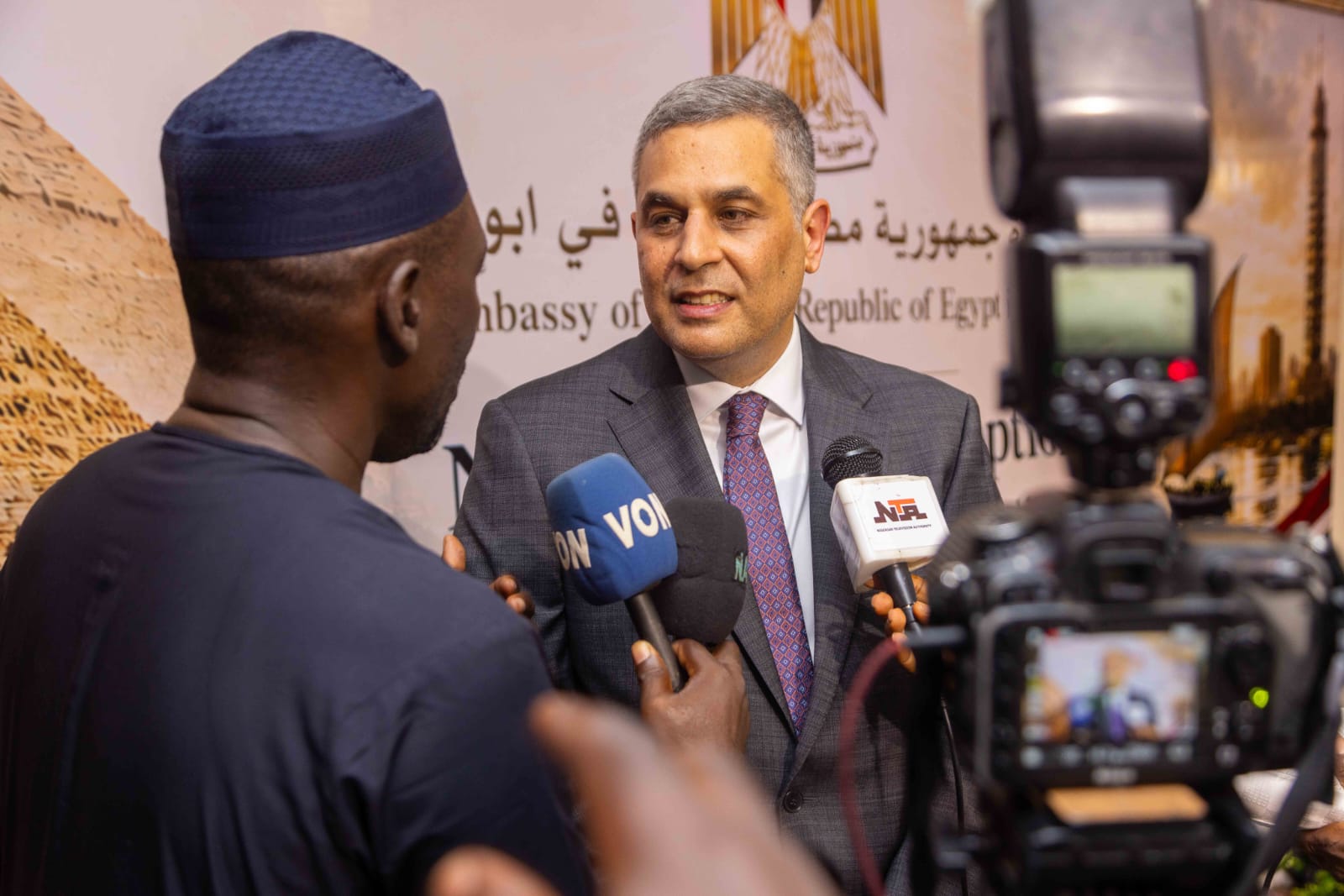
Egypt's ambassador to Nigeria, in an interview with "Zoom Africa News": Relations between Cairo and Abuja are historic and have risen to the level of a comprehensive partnership.
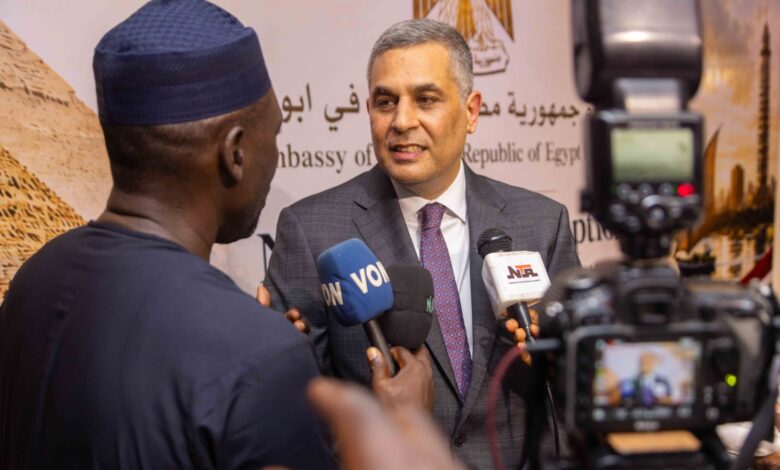
Egypt's ambassador to Nigeria during his interview with "Zoom Africa News":
Upgrading relations with Nigeria to the level of a “comprehensive partnership” reflects the vision of both political leaderships.
The political will is available to translate the distinguished historical relations into tangible development in the fields of agriculture and energy.
Egypt and Nigeria are two key forces for defending the interests of developing countries and achieving sustainable development on the continent.
We plan to launch a joint chamber of commerce to serve as a platform for enhancing communication between the business communities of the two countries.
We are looking to import gas from Nigeria to diversify our energy sources and transfer our expertise in converting cars to run on gas.
We invite Nigerian investors to consider Egypt as a regional gateway for exporting to the markets of Europe and the Middle East.
We encourage Egyptian and Nigerian banks to exchange branches to facilitate trade and investment.
“Arab Contractors is a credible partner in the development of infrastructure and service facilities in Nigeria.
EgyptAir connects Nigeria to the world with 18 weekly flights, and Cairo is a preferred transit point for Nigerian travelers.
Egypt’s healthcare and pharmaceutical sectors have a major competitive advantage in the Nigerian market.
Growing military and security coordination with Nigeria to counter terrorism in the Sahel and Chad Basin region.
Al-Azhar Al-Sharif is a fortified “soft power” that has protected Nigerian youth from extremist thought for centuries.
The presence of 10,000 Nigerian students in Egypt strengthens bridges of understanding and moderation between peoples.
Egyptian-Nigerian coordination is a “cornerstone” for activating the African Continental Free Trade Agreement.
We seek to launch a shipping line linking the ports of both countries to reduce transportation costs and facilitate trade.
Interview – Shaaban Bilal:
Ambassador Mohamed Fouad, the Ambassador of the Arab Republic of Egypt to Nigeria, affirmed the depth of the historical and strategic relations that bind Cairo and Abuja, noting that Egyptian-Nigerian relations are currently going through a phase of unprecedented momentum, culminating in their elevation to the level of “comprehensive partnership” during the political consultations held in January 2025.
In an exclusive interview with Zoom Africa News, the ambassador explained that this development coincides with the celebration of the 65th anniversary of the establishment of diplomatic relations between the two countries, reflecting a strong political will on the part of the two leaderships to develop cooperation in all fields, especially in the sectors of agriculture, food security, infrastructure, and energy.
Ambassador Mohamed Fouad stressed that Egypt and Nigeria, as the two largest and pivotal economic powers in the African continent, play a leading role in defending the interests of developing countries and promoting continental peace and security, especially in the fight against terrorism in the Sahel and Chad Basin region.
The Egyptian ambassador spoke about mutual investment opportunities, efforts to support trade exchange between the two countries, and efforts to enhance Egyptian-Nigerian cooperation in various fields.
And now to the text of the dialogue...
How would you describe the bilateral relations between Egypt and Nigeria at the present time? What are the most prominent features of the “harmony” between the political leaderships in Cairo and Abuja regarding continental and international issues?
Egyptian-Nigerian relations are currently characterized by a tangible degree of momentum and development, based on historical ties and a growing partnership at the political, economic and cultural levels. This year is of particular importance as the two countries celebrate the sixty-fifth anniversary of the establishment of diplomatic relations between them, a few months after Nigeria’s independence in October 1960.
Both countries have the political will to build on those historical ties to advance bilateral cooperation in all fields. During the political consultations held at the level of the foreign ministers in Cairo in January 2025, it was decided to raise bilateral relations to the level of a comprehensive partnership. It was noteworthy that six ministers participated in those consultations.
It brought together the foreign, agriculture and water resources ministers from each country, reflecting the two sides’ vision of the importance of these historical relations and their conviction of the need to translate the distinguished political relations that unite them into tangible and real development in various fields of bilateral cooperation, especially with regard to agriculture and food security, as well as trade exchange and investment movement.
Egyptian-Nigerian relations
On the other hand, the visions of the two countries’ political leaderships are consistent regarding African and international issues, which is of paramount importance to the continent’s issues, taking into account the status of Egypt and Nigeria as two pivotal countries in Africa, and two key powers with regard to defending the interests of developing countries. There is a keenness to continue coordination at the highest levels regarding these issues, foremost among them supporting efforts to establish peace and security in Africa and the need to combine regional and international efforts to combat terrorism, enhance continental integration, and reform the United Nations in a way that gives African countries more equitable representation, as well as coordination within continental and international frameworks to defend the interests of the continent and achieve sustainable development.
What is the embassy's plan to increase trade figures between the two countries, and what goods and services are you targeting to enhance their presence in the Nigerian market?
The embassy attaches great importance to advancing intra-regional trade and mutual investments between the two countries, and encouraging Egyptian companies to take advantage of the promising opportunities in various sectors in Nigeria. We are currently seeking to launch a joint Egyptian/Nigerian Chamber of Commerce led by representatives of the business community and the private sector in both countries, to be a platform to enhance communication between the business community in both countries with the aim of increasing trade exchange. It is planned to be launched on the sidelines of the fourth session of political consultations at the ministerial level scheduled to be held in Abuja during the coming months.
The embassy is striving to increase Egyptian exports and enhance the presence of Egyptian companies in the Nigerian market, especially in sectors where Egypt has comparative advantages, most notably pharmaceutical industries, contracting and building materials, agriculture and food industries, in addition to training, financial and technological services.
On the other hand, we see great opportunities to enhance economic integration through the possibility of importing quantities of natural gas from Nigeria, which has a huge gas reserve, which contributes to diversifying supply sources in Egypt, and building a balanced economic partnership that achieves the interests of both countries, and allows us to benefit from the potential for cooperation between two of the largest economies of the African continent.
How much Sectors To attract Egyptian investors to the Nigerian market?
Nigeria has great investment opportunities that make it one of the most promising markets in Africa. The healthcare and pharmaceutical industries are among the most prominent areas in which the Egyptian investor can achieve great success. Egypt has great expertise and capabilities in the healthcare sector, in addition to the clear competitive advantage of Egyptian pharmaceutical products in terms of high quality and reasonable prices compared to many other exporting countries. This provides broad opportunities for exporting and launching partnerships between Egyptian and Nigerian companies to meet the needs of the huge Nigerian market for medicine.
The contracting and construction sector is also one of the most important areas of cooperation between the two sides, especially with the Nigerian government implementing ambitious projects across the country to develop the infrastructure by building highways, bridges and railway networks, in addition to housing and service projects. This opens the door for Egyptian contracting companies that have great experience in implementing national projects inside and outside Egypt, and a number of them are already working in Nigeria to contribute to the implementation of these projects.
The agricultural sector also represents a promising area for bilateral cooperation, as Nigeria has about 35 million hectares of agricultural land and a large livestock population. The government seeks to increase agricultural productivity by expanding the use of advanced technology and improved seeds, an area in which Egypt has distinguished expertise. Cooperation between the two countries in this field can yield significant returns that benefit both, contributing to food security in both countries, through partnerships that allow for increased agricultural production of strategic commodities such as rice, wheat, and oil crops, with some of it used for local consumption in Nigeria and some exported to Egypt.
We have successful Egyptian models in Nigeria such as Arab Contractors. How do these companies contribute to transferring expertise?
Egyptian companies operating in Nigeria exemplify Egyptian efficiency and expertise, and have contributed over the years to building trust between the business communities of both countries. Arab Contractors is at the forefront of these companies, having operated in Nigeria since 1990. It has successfully implemented numerous infrastructure projects, particularly in roads and housing, earning the trust of the Nigerian government and solidifying its position as a reliable partner. EgyptAir also represents another model of Egyptian success.
Having operated in Nigeria for decades, it currently runs 18 regular weekly flights to three Nigerian cities (Abuja/Lagos/Kano), and has gained the trust of Nigerian travelers. It also plays an important role in connecting Nigeria to the world, as Cairo has become an important transit point for Nigerian travelers heading to many international destinations.
How can Egyptian-Nigerian coordination accelerate the implementation of the African Continental Free Trade Agreement?
The African Continental Free Trade Area agreement represents one of the most important strategic initiatives for achieving African economic integration, promoting intra-African trade and achieving sustainable development for the continent.
In this context, Egyptian-Nigerian coordination is of particular importance, given that the two countries are among the largest and most influential African economies. Egypt played a pivotal role during its presidency of the Ministerial Council of States Parties to the Convention to discuss ways to overcome obstacles that prevent the utilization of the advantages provided by the Convention. There is ongoing coordination with Nigeria in this regard, especially since it took over the presidency of the Council from Egypt in June 2026.
On the other hand, Egypt and Nigeria enjoy good air transport connections through EgyptAir, whether for transporting people or goods. What we lack is a shipping line that connects the ports of the two countries, as this is expected to facilitate trade between Egypt and Nigeria and reduce transport costs.
Both countries are pivotal in the field of energy and gas. Are there prospects for cooperation in the African Gas Pipeline project, clean energy and electricity?
The natural gas sector represents one of the most promising areas of cooperation between Egypt and Nigeria, especially in light of Nigeria’s huge natural gas reserves and Egypt’s accumulated practical experience in maximizing the use of natural gas in various applications.
Nigeria, through its Presidential Initiative on Compressed Natural Gas, seeks to expand the use of gas domestically as a fuel for transportation and industry. This opens the door for the transfer of Egyptian expertise in this sector, as Egyptian companies have extensive experience in implementing programs to convert vehicles to run on natural gas, and establishing conversion centers and refueling stations, which qualifies them to contribute to the implementation of Nigeria’s plans in this field. The two sides can also cooperate in the areas of training, capacity building, and the exchange of technical expertise regarding the various uses of natural gas, which supports sustainable development and reduces carbon emissions.
On the other hand, Egyptian companies operating in the petroleum sector are contributing to the ambitious projects being implemented in Nigeria in terms of modernizing oil refineries and constructing oil pipelines, given the distinguished expertise these companies possess in this field.
The continent faces common security challenges, particularly in the Sahel region and the Chad Basin. How is coordination between Cairo and Abuja being carried out on this issue?
Military and security cooperation is of great importance to both countries, stemming from a firm conviction among decision-makers in Egypt and Nigeria that the cross-border security threats, foremost among them terrorism, that the two countries face require a collective response and continuous coordination.
In this context, relations between Cairo and Abuja are witnessing growing security and military cooperation, based on the exchange of experiences and coordination on issues of common interest.
The Joint Military Committee is one of the most important mechanisms of this cooperation, as it holds periodic meetings to discuss ways to enhance military and security cooperation and develop the existing partnership between the armed forces of the two countries. Egypt also pays great attention to building the capabilities of Nigerian security and military personnel through training programs and specialized courses, based on its keenness to transfer its accumulated experience in the field of combating terrorism and extremism to its African brothers, foremost among them Nigeria.
How do Al-Azhar missions and scholarships contribute to strengthening ties between the two countries and protecting young people from extremist ideology?
The educational and cultural relations between Egypt and Nigeria represent one of the oldest and most important tributaries of bilateral ties, dating back several centuries, as Al-Azhar Al-Sharif included a special section for students from northern Nigeria known as the “Barnawiyya Section,” named after Borno State in northeastern Nigeria. Over the centuries, Al-Azhar received tens of thousands of Nigerian students, which made it highly revered and appreciated among Nigerian Muslims.
That close relationship still exists, as nearly ten thousand Nigerian students study in Egypt, whether at Al-Azhar or various Egyptian universities. Around 100 scholarships are allocated annually for Nigerian students to study at Egyptian universities, which makes Egypt one of the most important educational destinations for Nigerian students.
On the other hand, Al-Azhar Al-Sharif plays a very important role in spreading the principles of moderate and tolerant Islam through its educational mission in Nigeria, which includes 80 emissaries who teach the Al-Azhar curriculum in Islamic institutes and schools in various states of Nigeria, and they also contribute to combating extremist thought and promoting the values of moderate Islam, moderation and tolerance.
These educational and cultural ties are considered a fundamental component of Egypt’s soft power system in Africa. They not only qualify students scientifically, but also contribute to building bridges of understanding and communication between peoples, consolidating the values of moderation and centrism, and protecting youth from extremist ideas by spreading the enlightened centrist thought adopted by Al-Azhar Al-Sharif.
For decades, graduates of Al-Azhar and Egyptian universities have contributed to strengthening the bonds of friendship between the two countries, and many of them occupy influential political, economic, religious and community positions in Nigeria, which reflects the depth of the historical relations between Cairo and Abuja and confirms that education remains one of the most important pillars of the partnership between the two countries.
Exporters and investors have always complained about obstacles to transportation and bank transfers between African countries. What efforts is Egyptian diplomacy making to overcome these obstacles with the Nigerian side?
Nigeria has a sophisticated banking sector and a strong financial infrastructure, which provides an important basis for enhancing economic and investment cooperation between the two countries. The embassy is working in coordination with the relevant authorities in Egypt and Nigeria to encourage cooperation between banking institutions in the two countries to facilitate the flow of trade and investment, and to overcome any obstacles related to financial transfers and banking services.
In this context, the embassy encourages Egyptian banks to study the possibility of opening branches in Nigeria or establishing partnerships with Nigerian banks. It also communicates with Nigerian banks to encourage them to open branches in Egypt, which contributes to providing banking services to Egyptian exporters and investors, and facilitating financial transfers.
The financial and insurance services sector is considered one of the promising sectors for bilateral cooperation, as Egyptian insurance companies have expressed interest in entering the Nigerian market. The recent period has also witnessed growing cooperation between financial institutions in the two countries, most notably the Egyptian and Nigerian central banks and capital market authorities, which enhances investor confidence and advances economic relations between the two countries.
Egypt is witnessing a boom in new cities and the Suez Canal Economic Zone. What is your message to businessmen in Nigeria to explore investment opportunities in “New Egypt”?
Today, Egypt offers vast investment opportunities in light of the unprecedented development boom the country is witnessing, whether through the expansion of infrastructure projects and new cities that represent modern models of urban planning and sustainable development, or through the Suez Canal Economic Zone, which provides a unique strategic location that is a center for production and export to African, Arab and European markets, in addition to the availability of trained labor and educated cadres, which makes Egypt an attractive center for Arab and foreign investments.
In this context, we invite Nigerian investors to view Egypt not only as a large market but also as a regional gateway for investment and export to other markets in Europe, Africa and the Middle East, given its advanced infrastructure, attractive investment climate and investor-friendly laws.