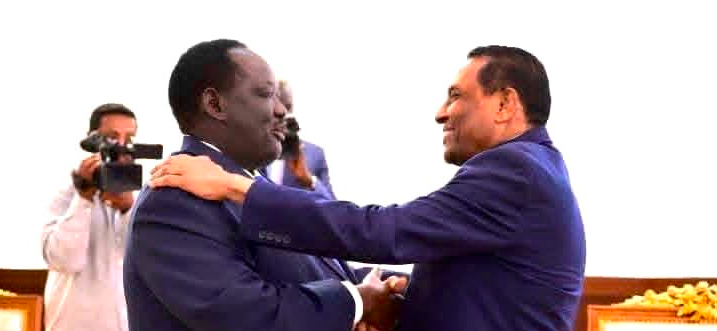
Sudan and South Sudan discuss political coordination during a meeting in Khartoum.
Developing joint cooperation between the two countries
Written by Ziad Abdel Fattah:
Sudanese Prime Minister Dr. Kamel IdrisOn Wednesday, the President of South Sudan, Tut Galwak, discussed ways to strengthen bilateral relations between the two countries during a meeting held in the Sudanese capital, Khartoum.
The meeting addressed mechanisms for developing joint cooperation between Sudan and South Sudan, in addition to discussing a number of files and issues of common interest, in order to support stability and promote mutual interests.
Expanding cooperation in economic fields

Both sides stressed the importance of raising the level of bilateral relations, with a focus on expanding cooperation in economic fields and strengthening political coordination in a way that serves the interests of the people of Sudan and South Sudan and supports the path of cooperation between the two countries.
The meeting was attended by the Secretary-General of the Sudanese Cabinet, Ali Mohamed Ali, the Undersecretary of the Ministry of Foreign Affairs and International Cooperation, Ambassador Muawiya Othman Khalid, and the Sudanese Ambassador to the Republic of South Sudan, Lieutenant General Essam Karar.
In another context, South Sudan achieved an environmental and historical milestone after the natural landscape of animal migration between the Boma and Padingelu regions was included on the UNESCO World Heritage List.
This is the first site from South Sudan to be added to the list since the country's independence, a move that reflects the region's global importance as one of the world's largest wildlife migration areas.
One of the world's largest animal migrations
The Boma and Padingelu region extends over a vast area of more than 37,000 square kilometers between the White Nile and the Ethiopian border, and every year witnesses a mass migration of nearly one million gazelles, deer and other types of wild animals across the plains and grasslands.
Environmental experts confirm that this natural landscape represents one of the most important environmental phenomena in the African continent, due to its great biodiversity and pivotal role in maintaining ecological balance and the continuity of wildlife species in the region.
Despite international recognition of the site's natural value, UNESCO decided to include it directly on the list of World Heritage in Danger, due to the challenges it faces, primarily armed conflicts, climate change, and human pressures that threaten the ecosystem and animal migration routes.