It's not just a weather crisis... How did the heatwave reveal the fragility of services in Tunisia?
Tunisia under the sun: When the heat reveals the depth of the wounds, the will to live remains stronger.
Written by Ulfa Al-Tarabulsi:
Since mid-July, Tunisia has been experiencing one of its most difficult periods summer Years ago, an unprecedented heat wave raised the temperature to nearly 47 degrees in Tunis and 49 degrees in Kairouan, leading to a record increase in electricity demand of 6,000 megawatts, a figure that far exceeds the national grid's estimated production capacity of 4,630 megawatts. The result was intermittent power outages, sometimes lasting for long hours, which in turn affected the supply of drinking water, given that the pumping stations belonging to the National Water Exploitation and Distribution Company also depend on electricity to operate.
Tunisia protests
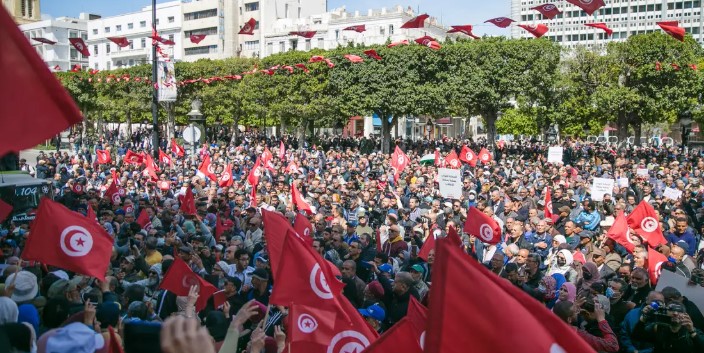
The public anger was real and understandable. On July 25, about 2,500 people took to the streets of Tunis, the capital, to express their dissatisfaction with the declining quality of public services and to demand clear answers from the authorities.
It is important to clarify that these movements were nothing but peaceful demonstrations, which fell entirely within the framework of freedom of expression guaranteed by the constitution, and did not witness any riots or violence whatsoever.
The House of Representatives dedicated a public session to discussing the issue, while the judiciary opened investigations to determine responsibilities within the Tunisian Electricity and Gas Company.
President Kais Saied described the situation as abnormal, demanding an end to the prolonged power outages.
But reducing this moment to a passing crisis is an incomplete reading. The explanations offered by experts do not point to a real scarcity of resources, but rather reveal a structural challenge related to infrastructure: consumption rising at a faster pace than production, an outdated electricity grid, and a still heavy dependence on imported natural gas.
Regarding water as well, the problem is not the scarcity of resources, as the filling rate of dams has exceeded 60% and reached 75% in some areas, but rather the deterioration of the distribution network itself.
There are positive signs on the horizon, as the World Bank has allocated $332.5 million to modernize the National Water Exploitation and Distribution Company, expand desalination plants, and install 100,000 smart meters.
A regional agreement was also signed last April with Algeria and Libya to regulate the management of shared water resources. These infrastructure projects will not solve the crisis of summer 2026, but they lay the foundation for a more resilient network in the coming years.
Tunisia is facing a difficult test today, a test that reveals the fragility of its infrastructure as much as it reveals the resilience of its people, who continue to take to the streets peacefully, demanding their right to electricity, water, and dignity, without losing faith in the possibility of reform.
The question that remains is not whether Tunisia is capable of overcoming this ordeal, as its history testifies that it is, but rather whether the state will respond with the speed and seriousness that a citizen exhausted by waiting deserves.