Narrative of African Peoples: The Pygmies “The Battle for Survival and Recognition”
numbers: Dr. Alia Amer: A demographic expert specializing in gender studies and representative of North African countries to the African Union for Population Studies
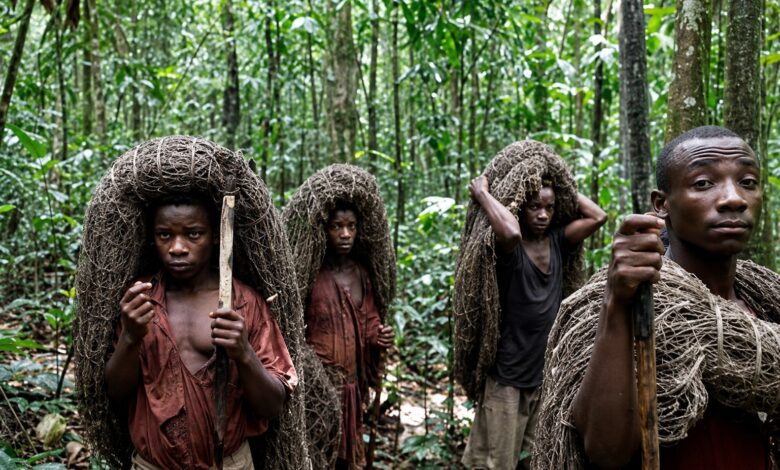
While the world speaks with increasing urgency about sustainable development and climate justice, one of humanity’s oldest forgotten histories lies deep within the rainforests of the Congo Basin. It is the narrative of the Pygmy peoples—or, as they prefer to call themselves, the Aka, the Bambote, and the Batua. These are not simply groups living on the margins of the African continent; they are the first guardians of one of the most complex ecosystems on Earth, and bearers of an oral culture that possesses an environmental intelligence that may elude 21st-century humans.
This group or lineage is small in number, but possesses striking and noteworthy characteristics. The first point to note, as mentioned in the introduction, is that the pygmy lineage is not limited to the African continent; its distribution extends eastward to the Pacific Ocean, where it is more widespread, though in smaller numbers. Scientists distinguish between the African and Asian groups by referring to them in Africa as "Negrillo," using the diminutive form of the Italian word.
The Asian group is called "Negrito," using the diminutive form in Spanish. In both cases, the term means "little Negro," and their small numbers wherever they are found are due to their occupation of hunting, gathering, and foraging for food, coupled with their inability to engage in productive work. They need a large, expansive homeland to find food for themselves and the animals they hunt. This was possible in ancient times, but later, as populations expanded, conquered lands, and engaged in herding and agriculture, the pygmies had no choice but to confine themselves to limited parts of their homelands, where they faced competition from people with more complex and productive economies. Therefore, we do not find pygmies living alone in any one region, except for the Andaman Islands in the middle of the Indian Ocean. Even these islands were corrupted by colonial rule, which turned them into a place of exile for certain groups of criminals.
The Pygmies of Africa are hunters, trappers, and gatherers. Their homelands were undoubtedly much larger in the past than they are today, encompassing the Bahr el Ghazal region, the Great Lakes, the forests and jungles of the Congo Basin, and extending to Cameroon and the coasts of Ghana. It is highly probable that they roamed freely throughout these areas before the arrival of Black Africans. Today, they are confined to the densest forests of Central Africa, in the Congo Basin, the Ituri region, and similar areas. They barely extend beyond the fourth parallel north and south of the equator.
The settlement of pygmies in Africa dates back to very ancient times. We know, in any case, that they were known to the Egyptians during the time of the pyramid builders. Egyptian rulers used to send expeditions south, bringing back African goods and treasures. Sometimes they would return with a pygmy. The pharaoh's throne considered the most valuable thing to come from the south to be a cheerful pygmy who could dance, play, and amuse with his movements. The ancient Egyptians left behind drawings and inscriptions depicting several of these pygmies.
It is certain that the Egyptian missions at that time did not go to the forests of Congo, but rather found what they were looking for in places much closer than the current homelands.
Pygmies are very short in stature, rarely exceeding 135 centimeters in height – unless mixed with other races. Their arms are very long relative to their legs, their skin is often dark reddish or yellowish-brown, and their bodies are covered with fine, downy hair. Their head proportions are either medium or slightly broad (79 to 81). This is one of their most important characteristics, and since they live among groups with a low head proportion, any high head proportion found in an African population is usually due to interbreeding with pygmies. Their noses are very broad, almost flat, and their eyes are large and protruding. Their faces are short, their jaws are prominent, and their lips are thick. Their hair is, of course, very curly.
The pygmies live in small, scattered groups, a necessity imposed by their hunting and gathering activities. Each group builds its small huts in a secluded spot in the forest.
They hunt with poisoned bows and arrows, and can even overpower large animals… We don't know how these pygmies felt when the various Bantu groups began to settle in their lands. But today, they live in harmony with their Bantu neighbors. They speak their languages and trade goods with them, giving them their hunting produce and receiving agricultural products like bananas and corn.
An example of such social mixing is found in the accounts of the Bambouti pygmies of the Ituri forests, who participate in circumcision ceremonies with their Bantu neighbors. When the time comes for this procedure in a particular area, the pygmy boys and their neighbors participate, performing the rituals necessary for this crucial stage in the lives of the boys, who then become members of society and transition from childhood to adolescence.
As for religious doctrine, the beliefs prevalent among the dwarves likely contain elements unique to them, alongside those they have adopted or been influenced by from the beliefs of their Bantu neighbors. The ancestor worship prevalent among all Bantu peoples does not appear to hold a significant place in dwarf religion. A central tenet of their faith is the veneration of a power they attribute to the heavens. Some see this power as connected to the creator of the universe. This celestial being is sometimes referred to as the lord of storms, lightning, thunder, and rain. Some groups give it a specific name, while others call it the ancestor. They offer it sacrifices such as a portion of the heart of a slaughtered animal or a portion of honey.
The Efe people, who live in the Ituri forests, call this being "Tori." They say he created everything and that everything returns to him. Before setting out to hunt, they pray to him: "Grant us food, Tori!" They believe that Tori is the one to whom the dead return and who slays evildoers with his lightning. The pygmies do not have tribes, though they do have small clans. However, some of their groups share a single name, such as the Akka in the Congo forests, the Bambote and Efe in the Ituri forests, and the Batwa in Uganda.
These, then, are the three groups: the Bushmen, the Hottentots, and the Pygmies. Few in number, some even facing extinction, they represent—despite their small populations—a significant phenomenon in Africa. It is the phenomenon of the continent's settlement over thousands and tens of thousands of years. The antiquity of these groups is evidenced by their isolated homelands, to which they were forced to retreat when waves of raiders and migrants began to advance from the north and east. The Bushmen and their relatives sought refuge at the extreme edge of the continent, while the Pygmies sought refuge in the dense forests.