The Ashanti people of Ghana: the region's most powerful empire
Ahmed Salem
The Ashanti people are one of the most distinctive peoples of West Africa, known for their adherence to customs and traditions.
They settled in the heart of Ghana, specifically around their historic capital, Kumasi, founding one of the region's most powerful and organized empires. Their legacy still lives on in a unique and incomparable way.
Ashanti clans
Instead of the center of power being dispersed among the Asante people, they are organized according to a structure based on matrilineal clans and a sacred monarchy headed by the Asantehene.
The golden stool, known as the legendary “Golden Stool” (Sika Dwa Kofi), the throne of the Asantehene, is not merely an ordinary seat as we might imagine, but rather it is the living symbol of the soul of the Asante nation.

The king's throne... descended from the sky
According to their inherited traditions, it descended from the sky, which grants it special sanctity, and it is strictly forbidden for anyone, including the king himself, to touch the ground or sit on it.
The palaces and royal shrines adorned with Adinkra symbols, laden with proverbs and ancestral wisdom, remain the ceremonial and spiritual center of Asante life.
Despite the gradual infiltration of modern influences, the Ashanti people proudly preserve their traditions; one can witness the colorful Akwasidae festivals.
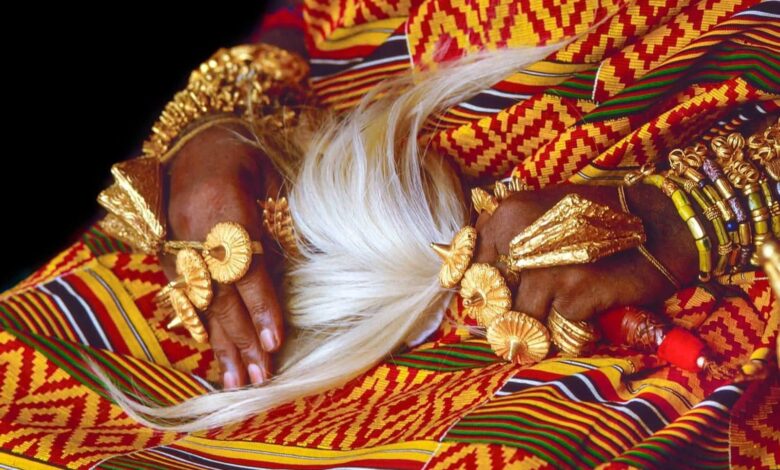
Leaders march in processions under enormous festive umbrellas, wearing the famous “Kente” cloths, hand-woven with patterns embodying history and philosophy, and adorned with gold jewelry, the metal historically associated with the empire's strength and wealth.
A living legacy of ancient gold weights
Many families still keep old gold weights (abrammuo) that were used in ancient times to weigh metal in trade dealings, and generations also inherit the stories of “Anansi,” the cunning and deceptive spider.

Many travelers visit the Ashanti people and explore their customs and traditions during their trip to Ghana. This ensures they build strong relationships and gain insights that most other visitors miss.