Written by: Badr Ahmed
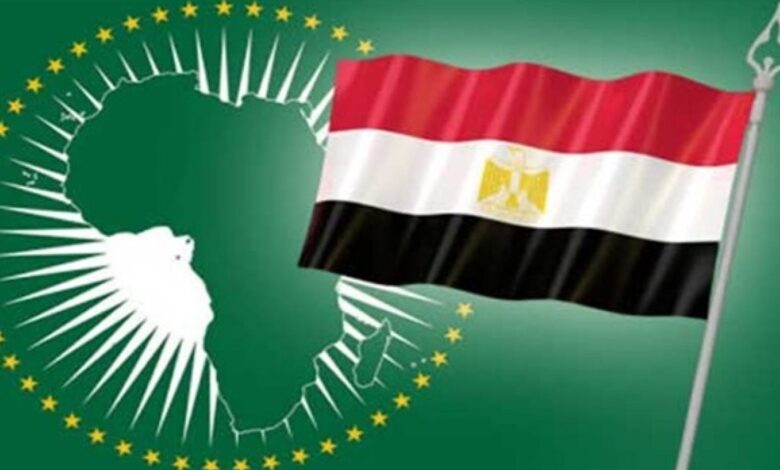
Egypt continues to consolidate its active presence within the African continent through a foreign policy based on strengthening partnership and cooperation with African countries in various political, economic, developmental and security fields, based on the historical, geographical and strategic ties that bind it to the countries of the continent.
The celebration of Africa Day on May 25 reflects Cairo’s growing interest in strengthening its regional role and supporting peace and sustainable development efforts in Africa.
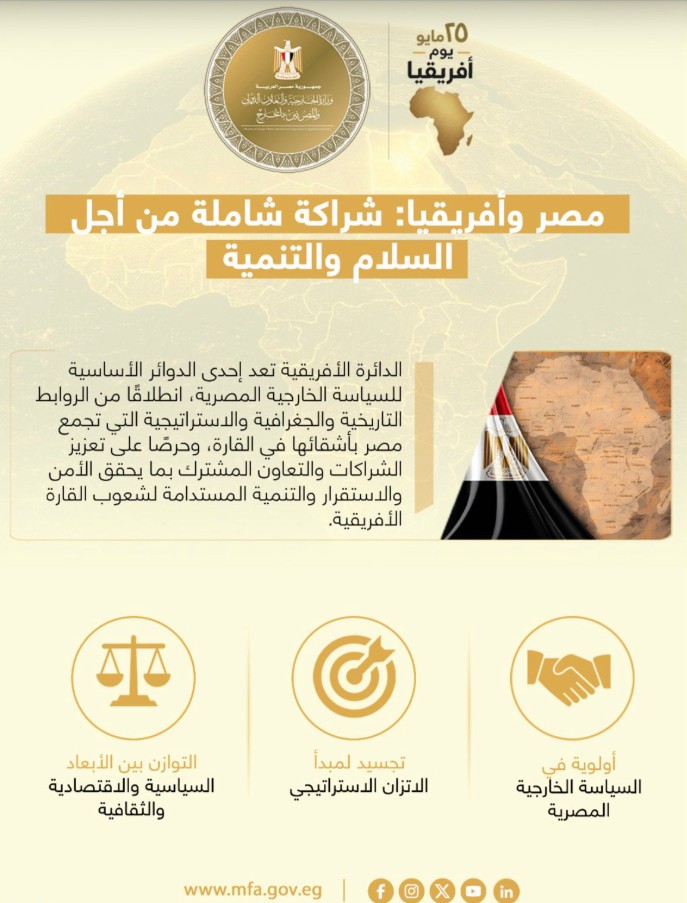
According to the official page of the Egyptian Ministry of Foreign Affairs, the African continent is one of the main pillars of Egyptian foreign policy, as the state adopts a vision based on achieving a balance between the political, economic and cultural dimensions, and embodying the principle of strategic balance in its relations with African countries.
Growing cooperation in the economy, security, and capacity building
Egypt also focuses on building integrated partnerships that contribute to achieving security, stability and development for the peoples of the continent.
In recent years, Egyptian-African relations have witnessed remarkable momentum through intensive diplomatic activity and mutual visits between the Egyptian political leadership and a number of African countries, including Rwanda, Uganda, Djibouti, Somalia, the Democratic Republic of Congo, Angola, Malawi, Tanzania, Chad and Kenya.
These moves have contributed to expanding areas of cooperation and strengthening political coordination with various regions of the continent.
The Egyptian Ministry of Foreign Affairs also played an active role in supporting economic and investment relations with Africa, through intensive tours by the Minister of Foreign Affairs to the countries of the Horn of Africa, the Sahel, Central, West and Southern Africa, accompanied by delegations of senior businessmen, investors and Egyptian companies.
These moves included holding seven economic forums aimed at strengthening the role of the private sector and opening new horizons for investment and economic integration.
In support of development and capacity building, Egypt intensified its efforts through the Egyptian Agency for Partnership for Development, which organized around 97 diverse training courses in security, technical and sectoral fields during 2025, in addition to providing scholarships and educational grants through Al-Azhar Al-Sharif and Egyptian universities for African students.
Egypt also strengthened its developmental and humanitarian role in the continent by sending more than ten medical convoys to a number of African countries during 2025, with the aim of supporting health systems and providing medical services to African brothers.
Cairo pays special attention to the Nile Basin countries, having launched the Egyptian Mechanism for Financing the Study and Implementation of Projects in these countries. This mechanism aims to support development projects that promote regional integration and sustainable development. The Julius Nyerere Dam project in Tanzania stands out as a prime example of Egyptian-African cooperation. Being implemented by the Arab Contractors Company and Elsewedy Electric, it is one of the largest infrastructure projects reflecting Egypt's commitment to supporting development on the continent.
In terms of peace and security, Egypt plays a pivotal role in supporting stability within Africa, especially in the Sahel region, through a comprehensive approach that combines security, development and intellectual dimensions to combat terrorism and extremism.
Egypt also takes charge of post-conflict reconstruction and development in Africa, and hosts the headquarters of the African Union Centre for Post-Conflict Reconstruction and Development.
Cairo has also been keen to strengthen its role within the institutions of the African Union, as it holds the chairmanship of the Steering Committee of the African Union Development Agency NEPAD during the period from 2023 to 2026, and it chaired the African Peace and Security Council in October 2024 and February 2026.
Egypt’s continued actions confirm that relations with Africa represent a firm strategic priority, based on joint cooperation and the achievement of mutual interests, which contributes to building a more stable and prosperous future for the peoples of the African continent.