Democratic Republic of Congo closes the door to imported cement... Will it succeed in protecting the local industry?
New restrictions to boost national production
Written by Omnia Hassan
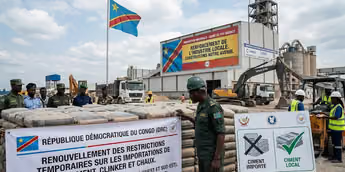
The government of the Republic renewed Congo Democracy is working on temporary restrictions imposed on the import of cement, clinker and lime in a number of regions of the country, in a move aimed at protecting local producers and supporting the national manufacturing strategy, in conjunction with the increasing demand for building materials as a result of the expansion of infrastructure and mining projects.
Under the new decision, restrictions on imports of grey cement and clinker will continue in the western and southeastern regions, while lime imports will remain restricted in the southeast, with an exception system in place that allows imports when local factories are unable to meet market needs.
Exceptions to prevent supply shortages
Despite the tightening of restrictions, the government was keen to avoid any supply crisis, as importers can submit formal exemption requests after providing approved documents through the national foreign trade platform, in cases where it is proven that local production is insufficient to meet industrial or consumer demand.
This system aims to strike a balance between protecting the national industry and ensuring the continued flow of building materials needed for development projects.
Local manufacturing is a top priority
The decision represents an extension of the policy that began in July 2024, when Kinshasa imposed temporary protectionist measures to counter competition from low-cost imports and encourage investors to expand domestic production capacity.
The government is banking on this policy to support the industrial sector and increase local added value, especially with the rising demand for cement in road, housing, mining and public works projects.
Large investments and logistical challenges
Recent years have witnessed a remarkable expansion in cement companies’ investments within the Democratic Republic of Congo, which has contributed to raising the production capacity of local factories. However, this development does not necessarily mean that products can easily reach all parts of the country.
Transportation challenges, weak infrastructure, and high logistics costs continue to hinder the efficient distribution of cement, which has prompted the government to maintain the exemption mechanism for areas suffering from supply shortages.
A bet on self-sufficiency and reducing imports
The move reflects a growing trend in a number of African countries towards using trade policies to protect domestic industries, reduce dependence on imports, stimulate local investment and create jobs.
But the success of this policy will remain dependent on the ability of local factories to provide sufficient quantities of cement and lime at competitive prices. If companies can meet the growing demand, the country will move closer to achieving self-sufficiency. If production gaps persist, exceptions may remain a necessary tool to meet market needs, which may reduce the actual impact of restrictions in reducing imports.