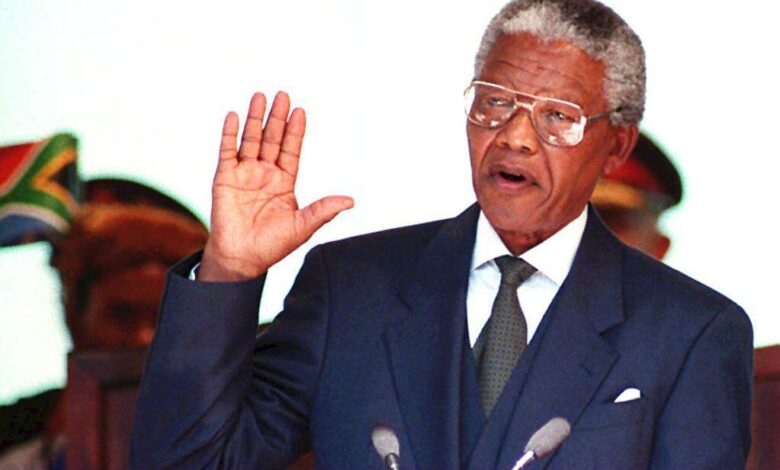
Nelson Mandela is considered one of the most prominent political leaders in contemporary history, and a global symbol of the struggle for freedom, justice and equality. He led South Africa in 1994, becoming the country’s first black president, after long political battles against racial discrimination and his long years of life imprisonment.
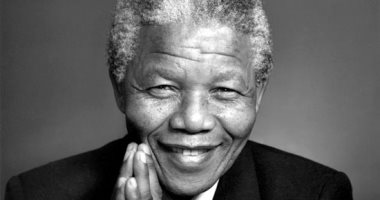
Who is Nelson Mandela?
Mandela was born on July 18, 1918, in the village of Mvezo in the Eastern Cape province of South Africa, and belonged to the royal family of the Thembu tribe. He received his early education in missionary schools, before studying law at Fort Hare University and then at the University of the Witwatersrand, where he began to take an interest in politics and the issues of racial discrimination suffered by the black majority in the country.
In the 1940s, Mandela joined the African National Congress (ANC) and co-founded its youth wing, which played a pivotal role in escalating the political struggle against apartheid. As the racist authorities tightened their grip on the anti-apartheid movement, Mandela helped organize large-scale protests and later contributed to the establishment of the ANC's armed wing in the early 1960s after peaceful resistance efforts proved ineffective.
In 1962, South African authorities arrested Mandela, and after a famous trial known as the “Rivonia Trial,” he was sentenced to life imprisonment in 1964. Mandela spent 27 years behind bars, most of it in the infamous Robben Island prison, where he became a global symbol of resistance and resilience, and international pressure mounted on the Pretoria government to release him and end the apartheid regime.
On February 11, 1990, Mandela was released following extensive international negotiations and pressure, beginning a new chapter in which he led historic negotiations with the white minority government to end apartheid. This process resulted in South Africa's first multiracial democratic elections in 1994, which Mandela won, becoming the country's first black president.
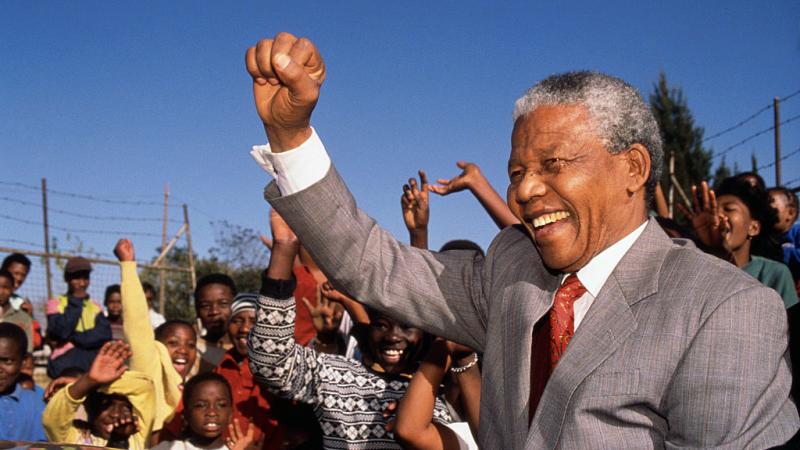
Mandela's presidency of South Africa
During his presidency of South Africa from 1994 to 1999, Mandela focused on achieving national reconciliation and rebuilding the country after decades of racial division. He also supported the establishment of the Truth and Reconciliation Commission, which aimed to address the legacy of past abuses and promote transitional justice. In 1993, he was awarded the Nobel Peace Prize, along with South African President F.W. de Klerk, in recognition of their role in the peaceful dismantling of apartheid.
After retiring from political life, Mandela continued his humanitarian work, advocating for human rights and combating poverty and disease, particularly AIDS in Africa. He died on December 5, 2013, at the age of 95, leaving behind a significant humanitarian and political legacy that made him one of the world's most prominent symbols of freedom. His name remains synonymous with peaceful struggle and a belief in the ability of people to overcome injustice and build a more just future.