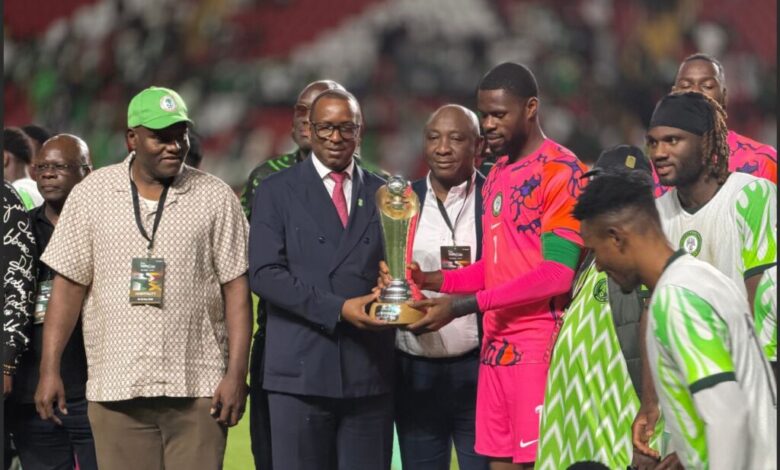
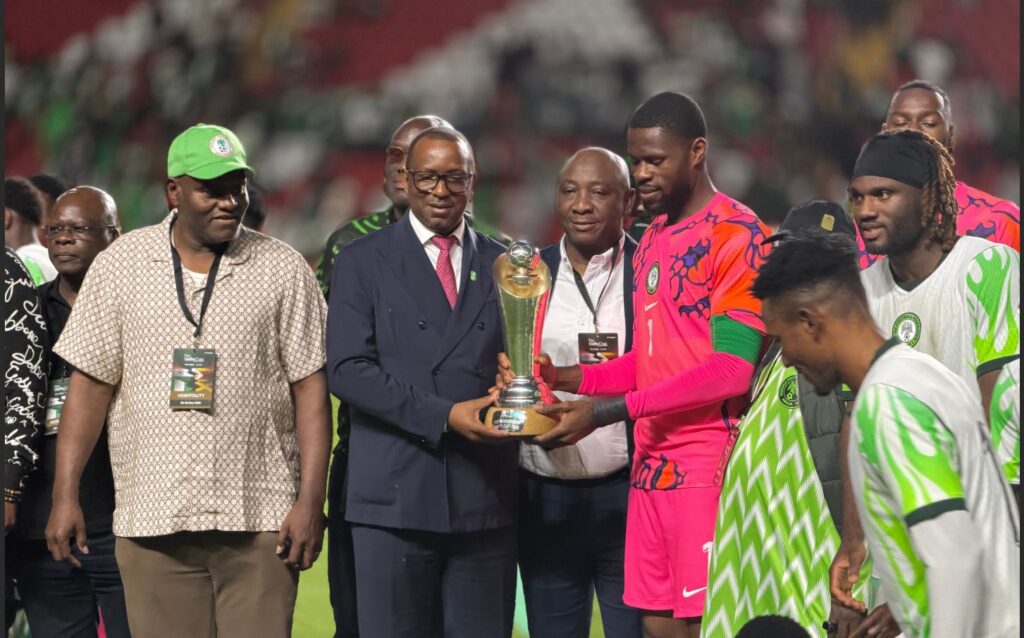
The national team was crowned Nigeria With the Unity Cup title for the fourth time in its history, after achieving a well-deserved victory over the Jamaican national team with three goals to nil in the final match held in the British capital, London, the Green Eagles continued their dominance of the tournament and retained the title for the second time in a row.
Hassan Youssef's brace leads the Green Eagles to victory over Jamaica and the title.
The match witnessed the brilliance of midfielder Alhassan Yusuf, who scored two goals, while Terim Mofe added the third goal, leading the Nigerian team to a great victory that confirmed their superiority throughout the tournament.
Nigerian midfielder Alhassan Yusuf scored two goals in the third and 91st minutes to ensure his team successfully defended the title.
The Green Eagles confirm their dominance of the tournament and claim their fourth title in history.
Yusuf opened the scoring early in the match before Terim Mofe doubled Nigeria's lead.
Movi's goal came after Femi Aziz bypassed his defenders and sent a cross into the penalty area, which the striker then put into the net.
Yusuf sealed the victory for Nigeria in stoppage time when he received a pass from Phil Otel and shot the ball past the Jamaican goalkeeper.
According to local media reports, the Green Eagles reached the final after defeating the Zimbabwe national football team 2-0 in the semi-final of the tournament.
Femi Azeez scored both goals in the semi-final match that ended in victory.
With this victory, Nigeria won the Unity Cup title for the fourth time, and a second consecutive championship after defeating Jamaica in the previous edition.
The Unity Cup is an annual international football tournament featuring four nations in London, and is notable for having large communities in the United Kingdom.
Africa at the 2026 World Cup: A historic participation and ambitions that go beyond the group stage
In a separate context, the African continent is entering the championship World Cup 2026 will have the largest representation in its history, after the number of seats allocated to it increased to 9 direct seats, with the possibility of the number reaching 10 teams through the global play-off, following the decision of the International Federation of Football Associations (FIFA) to expand the tournament to 48 teams.
This development is an important step that reflects the rapid growth of African football and its increasing presence on the global stage.
African national teams are making history
The African qualifiers saw the qualification of a group of the strongest teams on the continent, most notably Morocco, Egypt, Senegal, Algeria, Tunisia, Ghana, Ivory Coast, South Africa and Cape Verde, while the Democratic Republic of Congo succeeded in securing an additional place through the play-offs, raising the African presence to 10 teams in the upcoming historic edition.
This achievement is seen as evidence of the development of football infrastructure in many African countries in recent years.
Morocco leads the continent's ambitions
All eyes are on the Moroccan national team, which made history at the 2022 Qatar World Cup after becoming the first African and Arab team to reach the World Cup semi-finals.
The “Atlas Lions” hope to repeat or surpass the achievement, benefiting from a distinguished generation that includes players active in the biggest European clubs. Teams such as Senegal, Egypt and Algeria are also counting on their international experience and ability to compete with the world’s best.