Algeria: Popular discontent threatens local elections

Written by: Ayman Ragab
The political failure of the Algerian legislative elections held on July 2, 2016, did not end with the announcement of the results. Behind the victories of some and the defeats of others lies a more troubling reality: a record-breaking abstention rate that severely undermined the credibility of the electoral process. With local elections approaching, there is no indication that the root causes of this lack of trust are being addressed. On the contrary, all the ingredients for renewed rejection seem to be in place.
Political parties are facing an unprecedented crisis of confidence in these elections. The promises of renewal made in every election struggle to convince a public that no longer trusts empty rhetoric. If political parties continue to use the same methods for selecting candidates, local elections risk a similarly, or even more alarmingly, low voter turnout.
An issue that touches daily life
The danger is compounded because municipal elections are not merely a theoretical ideological debate, but a matter that directly impacts daily life: roads, urban planning, water, sanitation, transportation, lighting, markets, and public facilities. And because the municipality is the institution closest to the citizen, a loss of its credibility will have dire consequences for the relationship between residents and their institutions.

However, the party leadership still seems to prioritize internal politics over local realities. The sudden imposition of candidates, backroom deals, and forced nominations are all factors that threaten to further alienate voters. Citizens no longer demand specific media personalities or party figures; they expect representatives they know, meet with daily, and can genuinely share their concerns with.
If this separation does not occur quickly, political parties may experience a further loss of their local roots. Municipalities will gradually cease to be spaces for democratic representation, becoming mere administrative structures lacking genuine popular legitimacy.
Therefore, the issue goes beyond mere electoral competition; it concerns the ability of local institutions to maintain the trust of citizens. A local democracy that operates without the support of its residents gradually becomes a mere facade.
Historical responsibility
Political parties now face a historic responsibility; they have a few months to prove they understand the message voters delivered on July 2nd. Without deep self-reflection, openness to real-world actors, and genuine grassroots engagement, the local elections may not represent a renewal of democracy, but rather a perpetuation of a continuing crisis of representation.
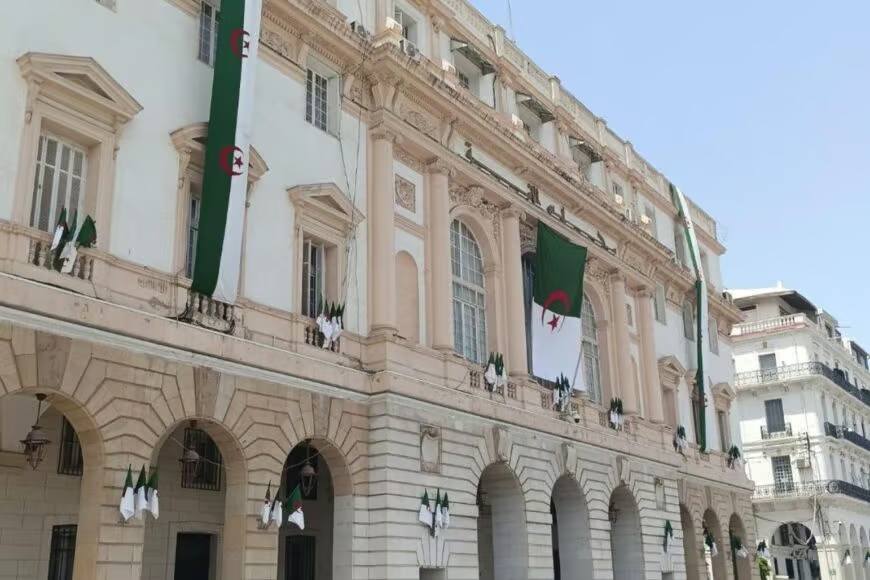
However, the municipality is the main face of the state. When it loses credibility, the entire institutional structure weakens. But all indications suggest that the era of superficial reforms is over. Without a break with old methods, without a genuine renewal of local elites, and without candidates rooted in their communities rather than candidates sent by the political machine,