Warning from the heart of the economy: Africa's richest man sounds the alarm | What is the reason?
Unprecedented pressures on aviation and agriculture
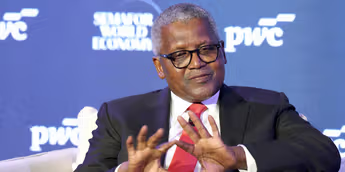
Written by Amina Hassan
Aliko Dangote, chairman of the Dangote Group and Africa's richest man, warned that the sharp rise in oil prices against the backdrop of tensions over the Strait of Hormuz threatens to cause widespread disruptions in vital sectors of the continent, most notably aviation and agriculture.
He explained that the daily fluctuations in crude oil prices, which sometimes reach $10 a barrel, put African airlines under severe financial pressure that could jeopardize their ability to continue operating.
Dangote noted that some airlines in Nigeria are already considering suspending their operations as a result of the significant increase in jet fuel costs, revealing the fragility of this sector, which is heavily dependent on imported fuel and affected by currency fluctuations.
Fertilizer prices soar, and food is in the crosshairs of inflation.
The crisis doesn't end with air transport. Dangote also pointed to a significant jump in fertilizer prices, with the price per ton rising from about $400 to $850 in just a few months. This increase, he warned, could disrupt the upcoming planting season unless governments intervene directly to support farmers and mitigate the impact of the costs.
In practical terms, this means the likelihood of higher food prices and lower agricultural production at a time when several African countries are suffering from supply chain disruptions and high transportation and energy costs.
A political breakthrough is possible, but the impact will be slow.
Although he noted that any diplomatic breakthrough between the United States and Iran could calm oil markets, Dangote stressed that a return to stability would not be immediate, as global supply chains would take time to regain their balance even in the best-case scenario.
South Africa tends towards monetary tightening.
In the same vein, South African Reserve Bank Governor Lesetja Kgango hinted at the possibility of adopting a tighter monetary policy to counter rising inflation risks. He stressed that waiting for price pressures to intensify could allow them to spread to wages and broader economic sectors.
He explained that if oil prices remain near $100 a barrel, along with the weakness of the local currency, the bank may raise interest rates later this year in an attempt to contain an inflationary wave fueled by rising fuel and agricultural production costs.
A difficult equation facing decision-makers
Caught between the energy shock and the agricultural input crisis, African economies face the dual challenge of curbing inflation without stifling growth. With global uncertainty on the rise, pressure is mounting on governments and central banks to make swift decisions that safeguard both economic and food security.