Investments worth 102 million euros between Kenya and the European Union
Ahmed Salem
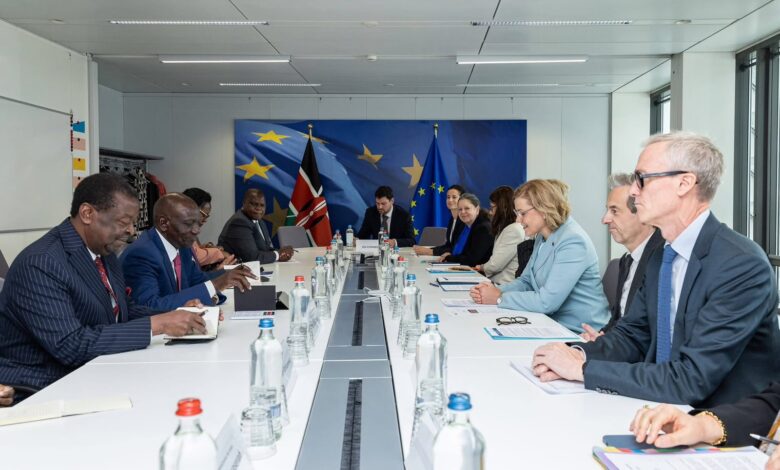
Kenya has announced a fruitful digital partnership with the European Union, with new investments of €102 million, equivalent to approximately 15.3 billion Kenyan shillings, aimed at accelerating digital transformation, expanding connectivity, and creating new opportunities for youth and businesses.
The Kenyan government expressed its welcome for the European Union’s support of 37 million euros to extend the Blue Raman submarine cable to Africa, which connects Djibouti, Somalia, Kenya and Tanzania, which will enhance connectivity, reduce bandwidth costs and support Kenya’s position as a leading regional digital hub.
Kenyan officials said: We had fruitful talks with the Executive Vice-President of the European Commission, Hina Verkonen, on deepening cooperation between Kenya and the European Union in the areas of trade, innovation and the digital economy.
A senior official added: “We reviewed the implementation of the Economic Partnership Agreement between the European Union and Kenya, under which Kenyan exports to the European Union have grown by more than 20% since it came into force, contributing to job creation and expanding opportunities for our farmers and manufacturers.”.
He continued: “We also welcomed the progress made within the framework of the Digital Partnership between the European Union and Kenya, particularly with regard to the Digital Dialogue and the Data Sufficiency Process, which will enhance digital trade, attract investment, and elevate Kenya’s status as a leading digital hub and a leading global destination for business process outsourcing (BPO) services, ranking eleventh.”.
Kenya’s partnership with the European Union continues to unleash investment, drive innovation, and promote shared prosperity.
In Kenya, agriculture is powered by artificial intelligence.
On another front, young farmers in Kenya are resorting to combining Agriculture Traditional methods and mobile phone applications are being used to build their livelihoods in the absence of formal jobs.
In Kericho County, Kenya, a typical day begins before sunrise for Chepkorir Rotich, a farmer in Kipoito village, western Kenya. By then, Rotich has milked her cows and sold the milk, fed her chickens, and returned to pick vegetables to fulfill pre-ordered deliveries. Her workday begins this way, and she performs it with enthusiasm.
When the 33-year-old mother of two left college more than a decade ago, she was excited and ready to join the formal workforce and get a full-time job.
She says: “I thought I would work as a business manager, but after a long job search, I accepted temporary job offers from three different companies. The highest salary was around $200 a month. This amount was not enough while I was living in Nairobi.”.