Sudan… Court issues a default judgment sentencing Hamedti and 15 others to death for the killing of the Governor of West Darfur
Sudanese court sentences Hemedti to death in absentia in Geneina case
Written by: Mohammed Omran
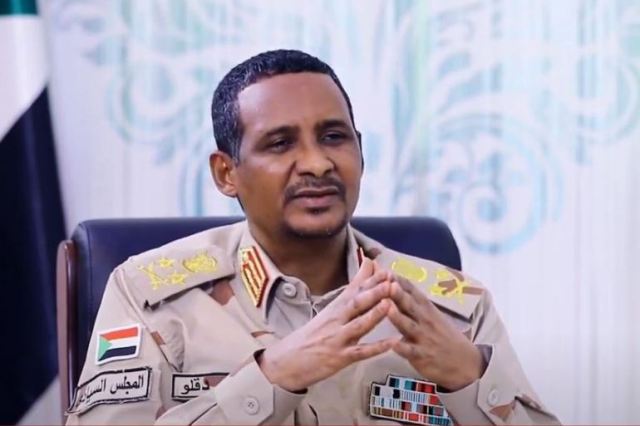
The Anti-Terrorism and State Crimes Court in Port Sudan, Sudan, headed by Special Judge Mohamed Al-Amin, today issued an ex parte death sentence by hanging as retribution against the commander of the rebel Rapid Support Forces, Mohamed Hamdan Dagalo, and 15 other Rapid Support Forces personnel in the case of the murder of the Governor of West Darfur State, Khamis Abkar, and other violations, after they were convicted of committing war crimes, crimes against humanity, and genocide.
The judge stated in the grounds for delivering the verdict: “The crimes committed are crimes against humanity, and they are among the most serious crimes punishable by Sudanese criminal law and international law. The crimes were committed as part of a widespread and systematic attack against the civilian population, and pursuant to a systematic criminal plan aimed at exterminating a specific ethnic group, women, children, the elderly, and the sick were killed inside hospitals.”.
مA Sudanese ruling orders the execution of Hemedti in absentia in the Geneina case.

He continued: “The governor of the state was also killed while under the protection of the state, and the forces that committed the crime used heavy weapons in residential neighborhoods. There was mutilation of bodies, looting, burning, rape, and forced displacement in extremely dire humanitarian conditions. These crimes were committed out of ethnic hatred and targeted the Masalit group for extermination and displacement, which multiplies their atrocity, as they also included the deliberate destruction of infrastructure in flagrant violation of international humanitarian law.”.

He stated: “The convicted were leaders in the state who exploited their influence and the state's weapons, which should protect citizens, to commit crimes instead of protecting them. The actions of the convicted resulted in the killing and displacement of thousands, the destruction of an entire city, and the demolition of a civilization and history. Due to the gravity of these crimes on social peace and state security, and to achieve general deterrence for anyone who would dare to target civilians, and specific deterrence for the convicted, and justice for the blood of the martyrs, the least these actions deserve is the imposition of the harshest penalties.”.

He said: “These three crimes do not become statute-barred and cannot be pardoned, as an international commitment for all countries. The Convention on the Prevention and Punishment of the Crime of Genocide of 1948 obliges states to punish perpetrators of genocide and not allow them to escape punishment. The Geneva Conventions of 1949 and their Protocols obligated states to prosecute and punish perpetrators of grave breaches.”.

And he completed: The verdict of the first convicted person: Mohammed Hamdan Dagalo (Hemedti) – Execution by hanging until death as a punishment, based on conviction under Articles 186, 187, 188, 189, and 191 of the Penal Code of 1991.
Second convict: Abdulrahim Hamdan Dagalo – Death by hanging until dead, as ta'zir, for conviction under Article 121 read with Articles 186, 187, 188, and 191.
Convict No. 3: Al-Gouni Hamdan Daglo – Death by hanging as ta'zir, for conviction under Article 122 read with Article 186.
Fourth convict: Abdulrahman Jumaa Barrak Allah – Execution by hanging to death as a ta'zir punishment, for conviction under Articles 186, 187, 188, and 191.
The fifth convict: Tijani Al-Tahir Karshoum – Execution by hanging until death as a reprimand, for conviction under Articles 186, 187, 188, 189, and 191.
The Sixth Convicted: Idris Hassan Haroun – Execution by hanging until death as a penalty, for conviction under Articles 186, 187, 188, 189, and 191.
The court decided to contact Interpol police to arrest and extradite the defendants and confiscate all the funds and properties of the Rapid Support Forces for the benefit of the Sudanese government.