Namira Najm calls for a more balanced narrative on African migration.
The importance of building fact- and data-based immigration policies
Written by: Mohammed Omran
The ambassador said Dr. Namira NajmAn expert in international law and migration and director of the African Migration Observatory, said that transferring third-country nationals to countries where they do not wish to settle, and where the population does not wish to receive them, raises fundamental questions about the future of these people and the future of the societies receiving them, as well as the resulting social and humanitarian repercussions.
In this context, she questioned the sustainability of the solutions currently being proposed by some European countries, and the extent to which they are compatible or incompatible with the rules, charters and international agreements that regulate human rights.
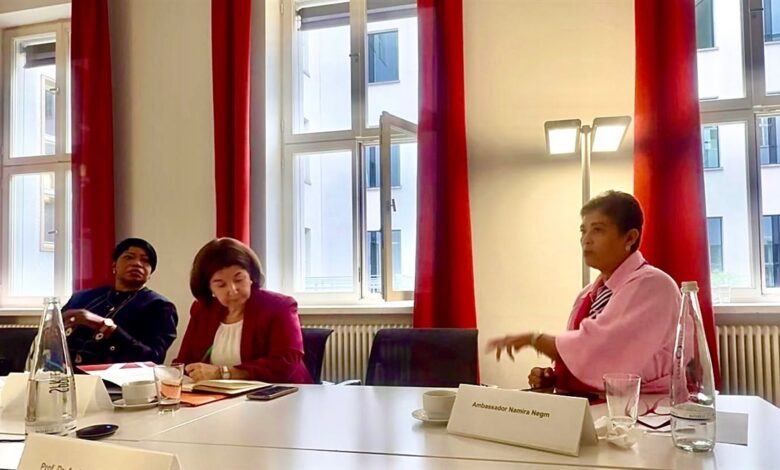
This came in her speech during the first meeting of the Steering Committee of Coordinators for the «Joint Initiative on Migration» initiative, launched by the Hertie School of Graduate Studies in the German capital, Berlin, in partnership with the Richard Gere Foundation.

The importance of building fact- and data-based migration policies and strengthening cooperation
In her speech, Ambassador Najm stressed that the initiative to change narratives about migration is a pivotal issue that directly intersects with the work of the African Migration Observatory, noting that the Observatory has already launched an internal initiative aimed at challenging prevailing narratives about African migration, which often contradict actual facts and figures.
She said that the discourse circulating in many media outlets and political platforms does not accurately reflect the reality of African migration, explaining that changing the prevailing narrative is a fundamental step towards building more balanced and realistic policies.
She added that this change should not be limited to presenting the African perspective only, but should also include European parties, because addressing the phenomenon comprehensively requires an integrated understanding of the responsibilities and challenges on both sides of the Mediterranean.

She explained that the decrease in the number of boats leaving irregularly from some countries does not necessarily mean a decrease in migration from their citizens, noting that migration routes are constantly changing, and that the Moroccan route is currently witnessing increasing numbers of different nationalities crossing, including migrants coming from countries that have succeeded in reducing irregular migration through other routes.
African ambassador warns against media misinformation that distorts the reality of migration.
It also called for greater attention to be paid to the transformations taking place in North African countries, which are no longer just transit countries, but in many cases have become destination and settlement countries for migrants, which imposes new social, economic and security challenges on them.
She explained that the challenges are not limited to issues of discrimination or racism towards immigrants, but also include the nature of relations and interactions between different African societies, considering that some of these problems reflect historical effects and a colonial legacy whose repercussions the continent is still dealing with today.
She pointed out that phenomena such as migrant smuggling are not limited to one side, but include networks and factors present on both the northern and southern shores of the Mediterranean, which calls for addressing the issue in a deeper and more comprehensive way.
She also stressed that while knowledge regarding the root causes of migration is largely available, gaps still exist with regard to data and accurate analysis of migration patterns and trends.
She emphasized that global figures show that the number of Asian and European migrants exceeds the number of African migrants, and that legal migration surpasses irregular migration in scale, contradicting many prevailing perceptions in public discourse. She stressed that these data necessitate in-depth demographic analyses to understand population shifts and their future implications.
She added that the debate on migration in the Mediterranean region is also linked to demographic changes, as some European societies face the challenges of aging populations and need a young workforce, while attracting talent from African countries may exacerbate the brain drain phenomenon and its impact on development efforts in countries of origin.

She also stressed the importance of understanding the reasons that drive thousands of young people to risk their lives to cross the Mediterranean Sea, despite the grave dangers surrounding these journeys, emphasizing the need to find practical solutions that contribute to saving lives and addressing the real motives for migration.
She stressed that the proposed study could provide significant added value by addressing these issues in a scientific, evidence-based manner, emphasizing that changing narratives begins with prioritizing facts and data over political considerations.

She added that the issue of immigration has often become a tool used in election campaigns and political speeches, while the figures and facts present a different and more complex picture.
She noted that employing reliable data and strengthening communication and media efforts can form a solid foundation for building a more balanced and equitable narrative on migration at the international level.

Ambassador Namira Najm stressed that the discussion about migration cannot be separated from the situations of forced displacement resulting from armed conflicts and terrorism, citing the situations in Sudan and other crisis hotspots in the African continent, and pointing out that migration is not only related to weak development in stable countries.
She stressed that studying the social dimensions of the transformation of transit countries into destination countries is no less important than studying the economic dimensions, noting that many countries in the region, including Libya, Tunisia, and sometimes Egypt, face increasing challenges related to how local communities interact with the presence of migrants and refugees.

She concluded by emphasizing that the success of government policies in this area does not depend solely on official decisions, but also requires broader societal acceptance, as government welcoming of immigrants does not necessarily mean their social acceptance, especially in light of the economic and social challenges facing host communities, which calls for a deeper understanding of these interactions when formulating policies related to immigration.