Africa NewsBusiness AfricaSliderEgypt
Egypt: Two agreements signed for the Jabal al-Zayt power plant with investments of $420 million.
Egypt's sovereign wealth fund played a prominent role in managing the deal.
Written by Ziad Abdel Fattah:
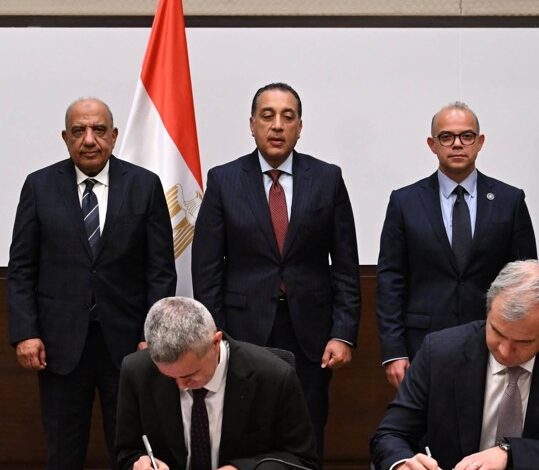
This evening, Dr. Mostafa Madbouly, the Prime Minister, witnessed cabinet The Egyptian, the signing ceremony of the investment, operation, and power purchase agreements for the Jabal Al-Zayt wind power plant in the Red Sea region, with a capacity of 580 megawatts, between the New and Renewable Energy Authority and the Egyptian Electricity Transmission Company on one side, and Alcazar Company on the other.
This took place in the presence of Engineer Mahmoud Esmat, Minister of Electricity and Renewable Energy, and Dr. Mohamed Farid, Minister of Investment and Foreign Trade.
The two agreements were signed within the framework of the State Ownership Document.
The signing of the two agreements comes within the framework of the State Ownership Policy document, which aims to maximize returns from owned assets, and in light of the National Energy Strategy, which aims to reduce dependence on fossil fuels and increase the contribution of renewable energies to the energy mix to reach 45% during the next two years.
The agreement stipulates that Alcazar Company will invest in, operate, and manage the assets of the Jabal Al-Zayt wind power plant in the Red Sea region through a project company established in accordance with applicable Egyptian laws and regulations. The project's investment value is $420 million, funded from external sources as part of efforts to attract further foreign investment. The agreement also includes the foreign partner's responsibility for the operation, technical management, and maintenance of the project, ensuring continuous operation according to the highest standards to maximize the value of the assets. Furthermore, the agreement stipulates the implementation of replacement, modernization, and efficiency upgrades to increase production capacity, while maintaining a minimum installed capacity of 580 megawatts throughout the contract period. The Egyptian Electricity Transmission Company will receive the generated power during the contract years.
The agreement is a model of partnership with the private sector, and a continuation of success and achievement, especially since the implementation of solar, wind and energy storage battery projects within the framework of the national energy strategy is carried out by the local and foreign private sector, and private investment takes the lead within the framework of the state’s vision for energy transformation and establishing a culture of spreading the use of renewable energies and relying on them.
Engineer Mahmoud Esmat explained that the state’s direction during this stage is based on maximizing the benefit from available resources, good management and exploitation of state-owned assets, maximizing returns from them and improving performance rates for affiliated companies and bodies, noting the support and assistance of the Ministry of Electricity and Renewable Energy for all aspects of partnership and models based on achieving common benefit.
Dr. Mohamed Farid, Minister of Investment and Foreign Trade, said that this deal is consistent with the Egyptian government’s directions aimed at empowering the private sector and increasing its role in economic activity in implementation of the State Ownership Policy Document, which contributes to enhancing investor confidence in the investment climate, and confirms the seriousness in implementing the program to expand the ownership base of state-owned companies, which the government aims to implement in order to enhance governance levels and improve the financial and operational indicators of government assets.
Egypt's sovereign wealth fund is managing the deal.
Farid praised the pivotal role played by the Sovereign Fund of Egypt in managing the deal from its inception by creating a competitive framework that resulted in attracting one of the world’s largest renewable energy companies through a contractual agreement that balances the rights of the state and the serious investor.