Electricity power in Africa: Who is leading the energy map and why is the north of the continent superior?
The backbone of economic growth
Written by Omnia Hassan
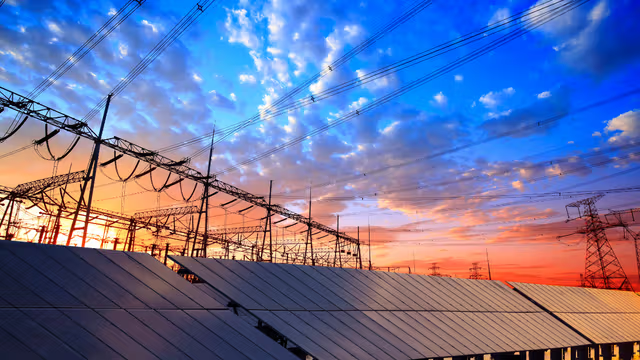
Electricity is the backbone of economic growth in Africa This is directly linked to the ability of countries to manufacture, attract investments and improve the quality of life. According to data from the International Energy Agency, five countries dominate the largest share of electricity production in the continent thanks to their natural resources and investments in energy infrastructure.
South Africa leads despite challenges
South Africa leads in electricity production in Africa With approximately 229,303 gigawatt-hours, more than 701 TPD3T of its generation is based on coal, which explains its large production capacity, but it presents it with environmental and operational challenges.
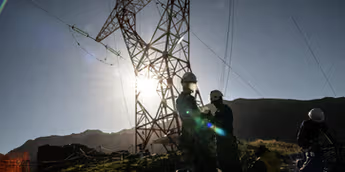
Despite this huge size, the country suffers from scheduled power outages due to pressure on the grid and the need to add new capacities estimated at about 15,000 megawatts. In contrast, its investments in solar and wind energy are expanding to reduce dependence on coal.
Egypt goes from shortage to surplus and export
Egypt ranked second with a production exceeding 200,000 gigawatt-hours. After years of supply shortages, it transitioned to a stable surplus in 2016, enabling it to export electricity. More than 751 T3T of its production comes from natural gas, alongside a significant expansion in solar and wind projects, particularly in the Red Sea region. This combination has given it operational flexibility and regional competitiveness.
Algeria is a gas powerhouse and a vast resource area.
Algeria produces more than 85,500 gigawatt-hours, with a reliance on natural gas exceeding 951 T3T. Its capacity is easily sufficient to meet domestic demand; however, experts point to the country's need to develop high-voltage transmission networks to support future industrial expansion.
Morocco: Renewed ambition and a balance of resources
Morocco generates more than 41,000 gigawatt-hours, yet it imports electricity during peak periods and its energy mix is based on coal, gas, solar and wind power, with a strategic goal of raising the share of renewables to more than 501 TP3T by 2030.
Nigeria's large production is not enough for its population.
Despite producing more than 40,000 gigawatt-hours, Nigeria suffers from a large gap between supply and demand due to its huge population and relies on gas and hydroelectric power, while citizens resort heavily to private generators and solar panels to fill the gap.
North Africa's electrical advantage
The list clearly shows the superiority of North Africa, with a strong presence of Egypt, Algeria and Morocco, in addition to Libya and Tunisia in the top ten. This reflects decades of investment in networks, natural gas and expansion in renewables, which has made the region the most electrically advanced bloc on the continent.