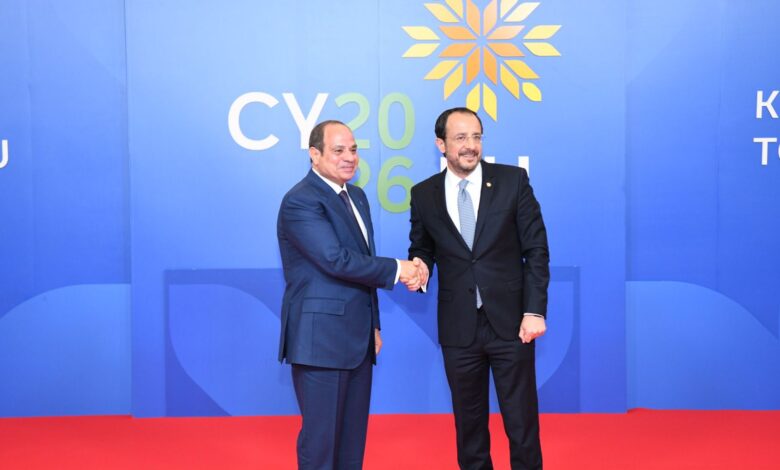
President Abdel Fattah participated SisiToday, in the Cypriot capital Nicosia, a consultative meeting was held between the leaders of a number of Arab countries, the leaders of the European Union countries, the President of the European Council, and the President of the European Commission.
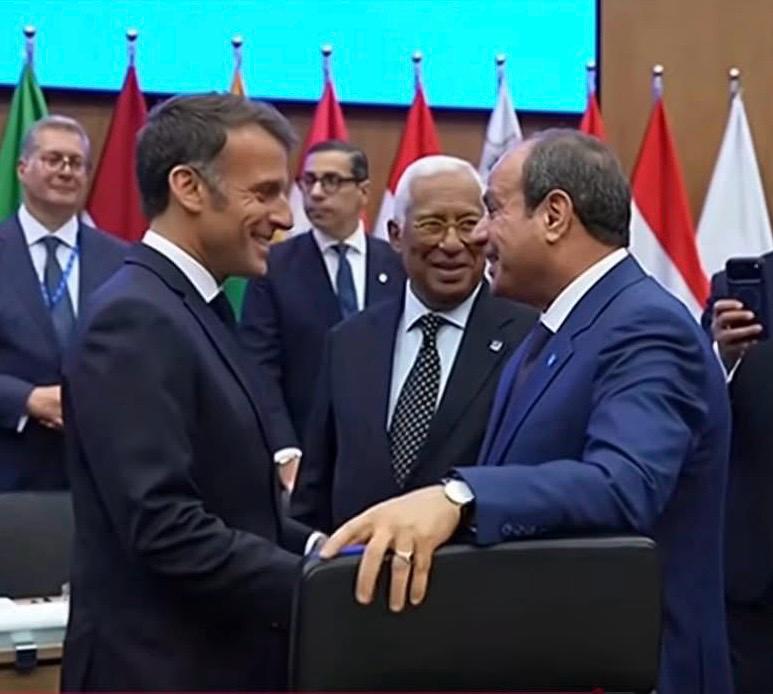
The official spokesman for the Presidency of the Republic stated that the meeting witnessed discussions between the leaders of Arab and European countries and European Union officials regarding the latest developments in the Middle East region, and ways to reduce the current escalation and restore regional and international peace and stability.
Ambassador Mohamed El Shenawy, the official spokesperson, noted that the meeting began with opening remarks from Antonio Costa, President of the European Council, President Nicos Christodoulides, President of the Republic of Cyprus, and Ursula von der Leyen, President of the European Commission, who welcomed the leaders participating in the meeting and stressed the importance of continuing consultations between the countries of the region and the European Union in order to maintain security and stability in the region.
The official spokesperson added that the president delivered a speech during the meeting, the text of which follows:
Text of President Sisi's speech
“"In the name of God, the most gracious, the most merciful
Nikos Christodoulides...
President of the Republic of Cyprus;
His Excellency Antonio Costa..
President of the European Council;
Ursula von der Leyen...
President of the European Commission;
Ladies and gentlemen;
Your Excellencies, Heads of State and Government of friendly Arab and European countries;
)May the peace, blessings, and mercy of God be upon you(
At the outset of my remarks, I would like to express my sincere thanks and appreciation to my dear friends, His Excellency President Christodoulides and Mr. Costa, for this kind invitation. I also express my gratitude to the friendly European leaders for their participation in this meeting, which is being held at a very critical time, as the Middle East region is rife with crises and conflicts that have threatened the hopes of its people for stability and development for years.
Our meeting today embodies a deep understanding of the shared destiny between the two shores of the Mediterranean. The crises that our region is witnessing do not stop at its borders; rather, their repercussions extend to affect everyone, especially the European continent, which is among the parties most affected by these developments.
Ladies and gentlemen,
The Iranian crisis has cast its dark shadow on the entire international situation, with serious repercussions for the stability of the region, navigation, the global economy, especially energy and food security and prices, and disruption of supply chains, in addition to the potential threat of nuclear contamination, which is a disaster in itself.
Egypt has been keen, and still is, to make strenuous efforts to contain the conflict and prevent its expansion, especially in light of the reprehensible Iranian attacks – which are unacceptable under any circumstances – that have targeted the Arab Gulf states, Jordan, and brotherly Iraq. We affirm our complete condemnation and total rejection of these attacks and any threats that affect the security of Arab countries.
I must also emphasize our full support for the security of our brotherly Arab countries, as it is an integral part of Egyptian national security.
Ladies and gentlemen,
The constants of the Egyptian position are clear and unambiguous; foremost among them is the emphasis that the political path remains the only acceptable way to get out of the current situation and achieve sustainable stability.
Egypt also stresses the need for full adherence to freedom of navigation and the importance of securing international shipping lanes, as a well-established and stable principle in international law.
Egypt affirms that recent developments have proven beyond any doubt that settling disputes peacefully has become a necessity, not an option, in addition to the necessity of establishing a zone free of weapons of mass destruction in the entire Middle East, and the comprehensive and non-selective implementation of the nuclear non-proliferation regime in the region.
The Palestinian issue remains the core of the crises in the region, and it is the central issue for the Arab world and the Middle East.
I emphasize the importance of not allowing any party to exploit the regional situation and take actions that undermine the prospects for peace and coexistence between the Palestinian and Israeli peoples on the basis of the two-state solution.
As the situation in the occupied Palestinian territories, including the West Bank, East Jerusalem, and the Gaza Strip, continues to deteriorate, I would like to present to you a number of essential facts:
First: The necessity of the Palestinian people remaining on their land and the importance of combining all efforts to stop the settlement policy and prevent any attempts to displace them or liquidate the Palestinian cause.
Second: The importance of the Palestinian National Committee assuming its responsibilities in managing the Gaza Strip, along with the rapid deployment of an international stabilization force to ensure monitoring of the ceasefire.
Third: Israel must commit to implementing its obligations under the first phase, and all parties must commit to moving forward with the implementation of the second phase of the ceasefire agreement in the Gaza Strip.
Fourth: Immediately begin early recovery and reconstruction projects throughout the sector to ensure the return of normal life for the Palestinian people.
From this standpoint, I urge the European Union and its member states to continue supporting the Palestinian cause and not allow it to be relegated on the list of priorities, as there is no alternative to the establishment of an independent Palestinian state, on the borders of June 4, 1967, with East Jerusalem as its capital, in accordance with the two-state solution, which has been agreed upon by the international community, as the only way to achieve lasting peace in the region.
Ladies and gentlemen,
Achieving stability in brotherly Lebanon is at the top of Egypt’s priorities, and we emphasize the importance of adhering to the ceasefire that was recently reached, and the need for all partners to join forces to prevent a resurgence of escalation.
I also affirm our full support for the efforts of the Lebanese state and its institutions, and we stress the need for the international community to assume its responsibilities in supporting Lebanese national institutions to play their pivotal role and to push for an end to the Israeli occupation and aggression.
I must also emphasize our firm position in support of the sovereignty and unity of our brotherly Sudan, and the need to support national state institutions, and to reject any equality between them and any parallel entities.
From this standpoint, Egypt is keen to engage with the various efforts aimed at restoring stability in Sudan and quickly reaching a humanitarian truce.
We look forward to the European Union continuing to play a supportive role, in line with our approach to the crisis in brotherly Sudan.
Ladies and gentlemen,
Egyptian-European relations are rooted in a long history of fruitful cooperation. These relations have risen to the level of a comprehensive strategic partnership in 2024 and culminated in the convening of the first summit in October 2025, in a manifestation of mutual awareness of the importance of cooperation in achieving common interests and enhancing regional stability.
Let me reaffirm our unwavering commitment to advancing this partnership in a way that serves the common practical interests of both parties, particularly in priority areas, as reflected in the three axes included in the new Mediterranean Charter, whose first action plan was recently adopted, concerning human development, the economy and sustainability, and security and migration.
In terms of human development, Egypt believes that human capital is the basis of sustainable development. Hence, joint investment in education, scientific research, and technology transfer contributes to the development process implemented by Egypt, and Egypt becomes an industrial hub for the European Union, in addition to improving the employability of young people, which reduces waves of illegal immigration by creating local job opportunities.
On the economic front, Egypt is working towards integration into European and global value chains, through industrial development and the commencement of exporting high value-added products. The experience of past years has proven that Egypt has been a reliable partner for the European Union, in line with the Union’s policy of diversifying supply chains.
As for migration, Egypt has fulfilled its responsibility in combating illegal migration, which has been appreciated by various partners.
Egypt also hosts about ten million expatriates who were forced to leave their homelands as a result of harsh conditions, without Egypt receiving anything but limited external financial support.
While fully aware of the importance of the migration issue to the European side, we look forward to an integrated partnership on this issue, including support for job opportunities, development and capacity building, and providing pathways for regular migration and mobility for study and work, so that the root causes of migration are addressed through a shared development agenda.
Distinguished guests,
What happens in Europe has repercussions in our region, and vice versa. Let us agree that the crises we have witnessed recently reveal beyond any doubt that there is a pressing need for dialogue, concerted efforts, cooperation, and support among partners to formulate common understandings that contribute to preventing the recurrence of such conflicts.
It has thus become clear that any party’s retreat into its own affairs is not the way to stability. Rather, the right way is based on dialogue with various partners, confronting problems with courage, sharing burdens and responsibilities, and formulating common ideas and visions aimed at achieving the best for our peoples and future generations.
Thank you.
Peace, mercy and blessings of God be upon you.
The official spokesperson stated that the heads of state and government also discussed during the meeting developments in a number of regional and international issues, as well as ways to resolve the various conflicts taking place in the region, in addition to the opportunities available to strengthen the partnership across the Mediterranean, in order to achieve common development and prosperity.
In this context, the President emphasized that any agreements reached must be fair and balanced, taking into account the concerns of all parties, particularly the Arab parties. He stated that this applies to the Iranian issue as well as the Syrian and Lebanese files. He stressed the paramount importance of any agreement concerning Iran addressing the security concerns of the brotherly Gulf Arab states. Similarly, the Presidents of Lebanon and Syria and the Crown Prince of Jordan commended the President's remarks and conclusions during the meeting.
On the sidelines of the meeting, the President met with the French President, the German Chancellor, the President of Romania, the Prime Minister of Denmark, the Prime Minister of Italy, the Irish Prime Minister, and the Secretary-General of the Gulf Cooperation Council.