Standard & Poor's classifies 25 African countries as affected by the Middle East conflict
Egypt at the forefront...
Written by: Mohammed Salem
Standard & Poor's Global rated RatingsIt is one of the three largest credit rating agencies in the world, ranking 25 African countries according to their exposure to the conflict in the Middle East, with Egypt, Mozambique and Rwanda topping the list of risks, while Nigeria, Angola, Congo-Brazzaville, Botswana and Morocco recorded the least exposure.
The model gives equal importance to five factors MainThe report cites trade dependence on the Middle East, exposure to energy shocks, external fragility, foreign exchange reserves at the start of the conflict, and public debt dynamics.
Standard & Poor's model assumes that the average price of Brent crude will be $85 per barrel until the end of 2026. The benchmark crude price fluctuated between $105 and $107 last week, with the Strait of Hormuz effectively closed, making the model about 25% below the market price.
The biggest shock to energy supplies ever
The International Energy Agency described this disruption as the biggest energy supply shock ever, the agency's executive director Fatih Birol said in an interview with CNBC on April 23.
The gap between the price forecast by Standard & Poor's and the trading price doubles the pressure on each item in the rating.
When the data is analyzed country by country, the table reveals a different picture than the main classification suggests. Countries that absorb the shock are not necessarily the ones expected to be protected, and those that withstand it are not necessarily the ones expected to be fragile. Three simultaneous reports released in April show that the key factor is the depth of local value chains.
Countries least at risk
Nigeria is ranked among the countries least exposed to sovereign risk in the Standard & Poor's index, thanks to its status as a net exporter of oil.
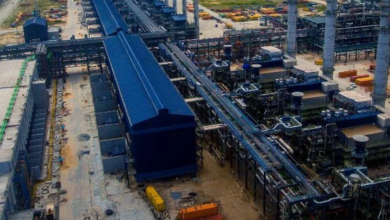
The deeper transformation lies in the Dangote Petroleum Refinery, the world’s largest single-line refinery with a production capacity of 650,000 barrels per day, which has been seeing an increase in its production capacity since 2024.
Between January and April, this unit helped raise the value of the naira to less than 1,400 naira to the dollar from more than 1,600 naira, and reduced gasoline prices to about 1,000 naira per liter from 1,500 naira, with fuel subsidies to be eliminated in 2025, according to data compiled by the Vanguard newspaper and sources in the Nigerian oil sector.
Standard & Poor's data showed that Egypt, ranked as the most vulnerable sovereign country, is currently spending 68.6% of its government revenue on interest payments.
Mozambique, ranked second, has external debt of 2,431 TP3T of its current account revenues, while offshore liquefied natural gas projects operated by Total Energies and Eni have faced delays since 2021.