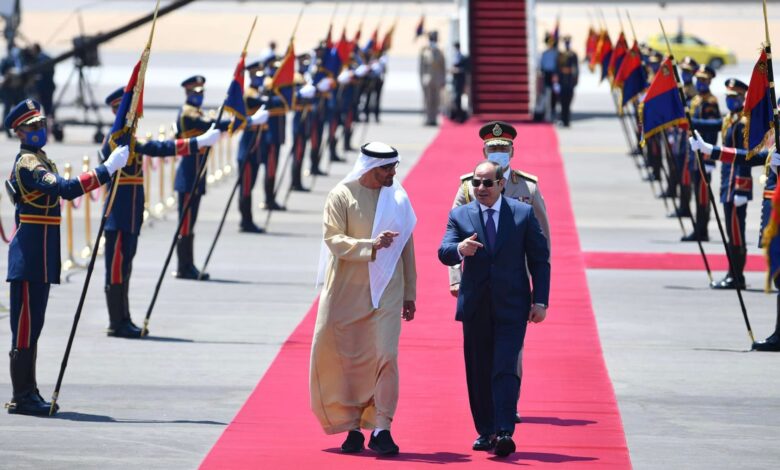
President Abdel Fattah El-Sisi received, today at El Alamein City Airport, the President of the United Arab Emirates, Sheikh Mohamed bin Zayed Al Nahyan, on a fraternal visit that reflects the depth of the historical and strategic relations between the two countries. The visit comes at a time when the region is witnessing rapid developments that necessitate strengthening coordination and consultation between the two leaderships.
President Sisi emphasized, during his meeting with his Emirati counterpart, that Sheikh Mohammed bin Zayed is a valued guest in his second home, Egypt. He stressed the special importance the United Arab Emirates holds for the Egyptian state and people, given the close ties that bind the two countries at the political, economic, and investment levels.
Confirmation of the depth of historical relations
For his part, Sheikh Mohamed bin Zayed Al Nahyan expressed his appreciation to President Sisi for the warm welcome, emphasizing that the relations between the UAE and Egypt are based on deep-rooted fraternal and historical ties, and that continuous coordination between the leaderships of the two countries represents a fundamental pillar for supporting security and stability in the region.
Egyptian-Emirati relations are witnessing continuous development in various fields, as the two countries are linked by a strategic partnership that includes investment, energy, trade, and development files, in addition to political coordination on regional and international issues.
Discussions on Middle East developments
Ambassador Mohamed El-Shenawy, the official spokesperson for the Presidency of the Republic, explained that the discussions between the two presidents covered the overall bilateral relations and ways to strengthen them, in addition to discussing the most prominent regional and international issues of common interest.
The meeting focused on developments in the Middle East amid the escalating military and security tensions in the region. Both sides stressed the importance of intensifying efforts to contain tensions and prevent the conflict from widening, which threatens the region's security and stability.
Continuous coordination to confront regional challenges
The two presidents affirmed the importance of continuing consultation, coordination, and joint action on various issues, contributing to supporting regional security, maintaining regional stability, and promoting political and diplomatic solutions to existing crises.
They also emphasized the need for continued coordination between the two countries in light of the current challenges, reflecting the pivotal role played by Cairo and Abu Dhabi in supporting Arab security and strengthening regional stability.