Digital currency is shaking the foundations of the naira... Is Nigeria entering the era of "dollarization"?
The world's largest cryptocurrency markets
Written by Omnia Hassan
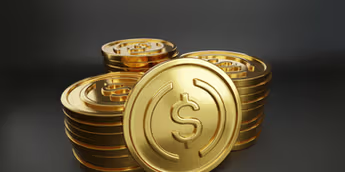
Witnesses Nigeria There is a rapid transformation in the world of digital payments, with increasing reliance on stablecoins pegged to the US dollar, in a phenomenon that reflects a profound change in the behavior of individuals and companies towards financial transactions.
While these currencies offer faster and cheaper solutions for cross-border transfers, economists and the International Monetary Fund warn of their potential repercussions for the future of Nigeria’s national currency, the naira.
Nigeria is at the forefront of the African digital revolution.
Nigeria has become one of the world’s largest cryptocurrency markets, attracting approximately $59 billion in digital asset inflows between July 2023 and June 2024, according to data cited by the International Monetary Fund. It also ranked second globally in Chainalysis’s 2024 Cryptocurrency Adoption Index.
Nigeria's influence is most pronounced in the stablecoin market, accounting for approximately 60% of total stablecoin flows into sub-Saharan Africa, making it a major hub for the continent's digital economy growth.
Why do Nigerians prefer stable currencies?
Stablecoins rely on pegging their value to traditional assets such as the US dollar, which gives them greater stability compared to volatile digital currencies such as Bitcoin.
This stability has made it an attractive option for citizens and businesses in Nigeria, especially given the fluctuations in the naira exchange rate, high inflation rates, and the difficulty in obtaining foreign currency.
Freelancers, students, and importers can now make international money transfers within minutes via smartphones, bypassing traditional banking procedures and their high fees.
Economic gains and increased risks
Recent studies indicate that 951,000 Nigerians surveyed by international organizations in 2026 preferred receiving payments in stable currencies rather than the naira. This is attributed to lower remittance costs, as sending money to sub-Saharan Africa remains among the most expensive globally.
However, the International Monetary Fund believes that these gains come with growing risks, most notably what is known as ”digital dollarization,” meaning the gradual shift of individuals and companies to holding and using the digital dollar in daily transactions instead of the local currency.
The challenge of regulation and protecting monetary sovereignty
The IMF warns that if this trend continues, it could lead to a decline in demand for the naira, weakening the Central Bank of Nigeria's ability to manage monetary policy and control inflation and economic activity. It could also make it more difficult to monitor capital flows and combat financial crimes.
Faced with this reality, Nigerian authorities are moving towards adopting more flexible regulatory frameworks, by strengthening cooperation between the central bank and the securities and exchanges authority, with the aim of integrating digital assets into the formal financial system, and striking a balance between supporting innovation and protecting economic stability.
Between promising opportunities and potential risks, Nigeria today faces a real test to determine the shape of its financial future in the age of digital currencies.