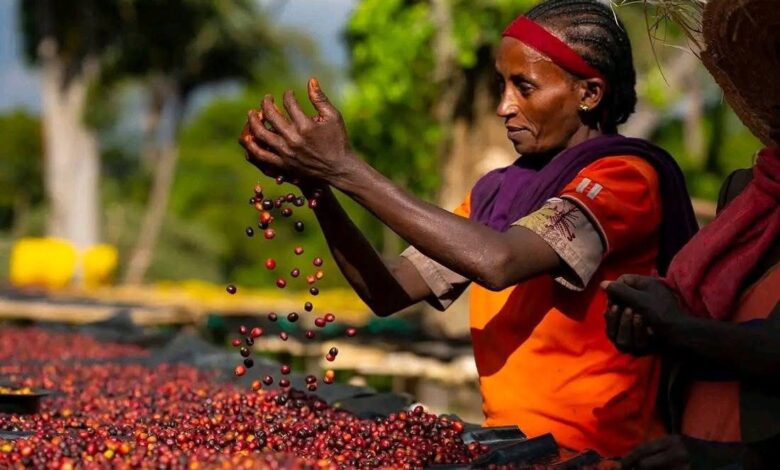
Ethiopia is intensifying its efforts to become the world's second-largest coffee producer.
Ahmed Salem
The Ethiopian Coffee and Tea Authority (ECTA) announced that it is working to accelerate its efforts to make Ethiopia The world's second largest coffee producer after Brazil, through modernizing the sector, increasing productivity and expanding the use of modern technologies.
The Deputy Director-General and Head of the Coffee, Tea and Spices Development Sector at the Authority, Tagai Nuru, said that the Authority is cooperating with research institutions to develop production and mechanize coffee cultivation, noting that it has obtained 47 varieties of drought and disease-resistant coffee with the aim of renewing farms and replacing old trees with more productive and resistant varieties.
He explained that the shift towards mechanized agriculture is one of the main pillars for achieving the country’s production goals, noting that the Authority has allocated land and provided credit facilities, in addition to tax exemptions on the import of agricultural equipment for the benefit of 100 major coffee exporters.
He pointed out that the average coffee production in Ethiopia is currently about 10 quintals per hectare, but the experience of the model farmers group “Kirshashi” showed the possibility of raising productivity to 62 quintals per hectare using modern mechanized farming methods.
“Tagay” stressed the need to modernize traditional production systems and adopt modern technologies, calling on investors to strengthen cooperation with the government to support the transformation taking place in the coffee industry, which will contribute to enhancing Ethiopia’s position in the global coffee market.
Agreement to develop housing projects in Ethiopia
In a separate context, the government of Central Equatoria State and the Federal Housing Corporation of Ethiopia signed a strategic partnership agreement in the field of housing development during an official ceremony held in the capital, Juba, in a move aimed at promoting urban development and expanding infrastructure and housing projects in the state.
The Governor of Central Equatoria State, Emmanuel Adil Anthony, confirmed that the agreement comes within his government’s vision to bring about a qualitative transformation in urban development in the city of Juba, noting that the historical relations between South Sudan and Ethiopia formed a solid foundation for this new partnership.
The governor explained that the state government is committed to immediately commencing the implementation of the agreed housing projects, which will contribute to meeting the growing demand for housing units and improving urban planning.
For his part, the CEO of the Ethiopian Federal Housing Corporation, Rashid Kemal, said that the partnership is not limited to construction work only, but also includes supporting sustainable urban development through the transfer of technical expertise and modern technologies necessary for project implementation.
He added that the first phase will begin in Central Equatoria State, and will expand in the future to include other cities and regions in South Sudan.
The agreement aims to enhance direct cooperation between the two sides in the areas of infrastructure and housing, to keep pace with the rapid urban expansion in Juba, and to meet the need for organized urban development, in addition to revitalizing the real estate and investment sector in the state.
The signing ceremony was witnessed by the Ethiopian ambassador to South Sudan, along with a number of government officials and representatives of relevant authorities.