Egypt and Uganda discuss enhancing water cooperation and sign a $6 million implementation plan.
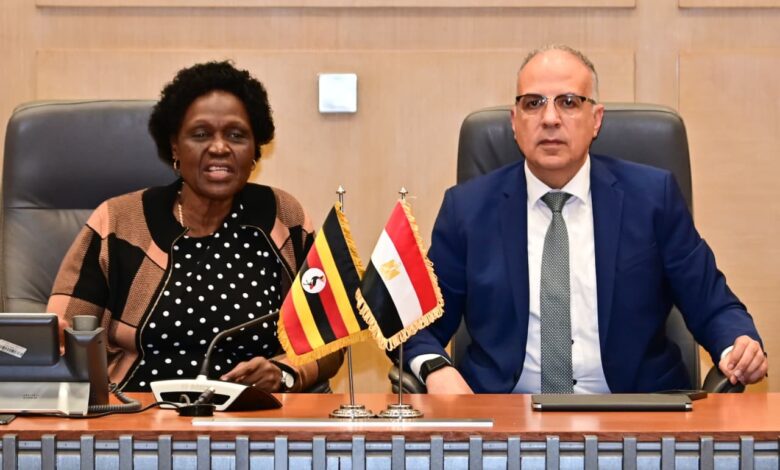
Hani Sweilem, Minister of Water Resources and Irrigation, held a meeting with Beatrice Atem Anwar, Minister of State for Environment Affairs of the Republic of Uganda, to discuss ways to enhance bilateral cooperation in the field of water, within the framework of the historical relations and fraternal ties that unite the two countries, and Egypt’s keenness to develop its relations with the countries of the African continent.
During the meeting, the Egyptian minister affirmed his country’s commitment to supporting development efforts in the Nile Basin countries, stressing the importance of strengthening cooperation in the field of integrated water resources management, especially with the basin countries, in order to achieve common interests and contribute to addressing water challenges.
Meetings of the Egyptian-Ugandan Steering Committee
The meeting witnessed a review of the results of the meetings of the Egyptian-Ugandan Steering Committee, which were held in Cairo on March 30 and 31, 2026, where the minutes of the meetings were signed and an executive action plan was agreed upon to activate the memorandum of understanding signed between the two countries in August 2025, worth $6 million.
The plan includes the implementation of a number of projects, including the construction of water reservoirs, the drilling of new groundwater wells, the development of existing wells and their conversion to solar power, in addition to training and capacity-building programs for Ugandan personnel.
The meeting also discussed projects and studies proposed for implementation through the financing mechanism launched by Egypt with a value of $100 million, to support development and infrastructure projects in the countries of the southern Nile Basin, within the framework of strengthening regional cooperation and achieving sustainable development.
Water weed control
Cooperation between the two countries dates back to 1949, when Egypt contributed to financing the construction of the Owen Falls Dam, representing an early model of regional partnership.
Egypt has also implemented a number of projects in Uganda, most notably the project to combat aquatic weeds in Lakes Victoria, Kyoga, Albert and the Kagera River, which has contributed to improving navigation, fishing and the environmental situation, and whose sixth phase, which was launched in 2023, is currently being implemented.
Areas of cooperation also included the development of river marinas and fish markets, the construction of groundwater wells and rainwater harvesting dams, which contributed to providing drinking water and improving livelihoods, as well as the implementation of a flood reduction project in the Kasese region through protection works on the Nyamwamba River, which enhances the protection of local communities and infrastructure.