Will digital taxes become Africa's weapon to regain its revenues?
Guinea imposes new fees on foreign digital services
Written by Mohamed Omran
The battle between governments and global technology companies is no longer just about data or Digital influenceIt has even extended to a new arena, namely taxes. With the rapid growth of the digital economy and the expanding influence of global platforms within African markets, the countries of the continent are increasingly moving towards imposing new tax frameworks that target the revenues generated by these companies within their borders.
Will digital taxes become Africa's weapon to regain its revenues?
In this context, Guinea has joined a growing list of African countries seeking to regulate the digital economy and enhance their technological sovereignty by imposing fees on foreign digital services and directing the proceeds towards funding digital infrastructure, innovation, and cybersecurity, in a move that reflects a broader shift in Africa’s relationship with global technology giants.
On the night of May 21, 2026, Guinean national television broadcast a decree signed by the transitional president, General Mamadi Doumbouya, which included detailed measures to reshape the country's digital policy. The decree formally established the Digital Compliance Charge (RCN), which targets foreign digital services consumed within the territory of the Republic of Guinea, and announced the creation of two new entities: the Digital Analysis and Regulation Platform (PARN) and the Digital Sovereignty Fund (FSN).
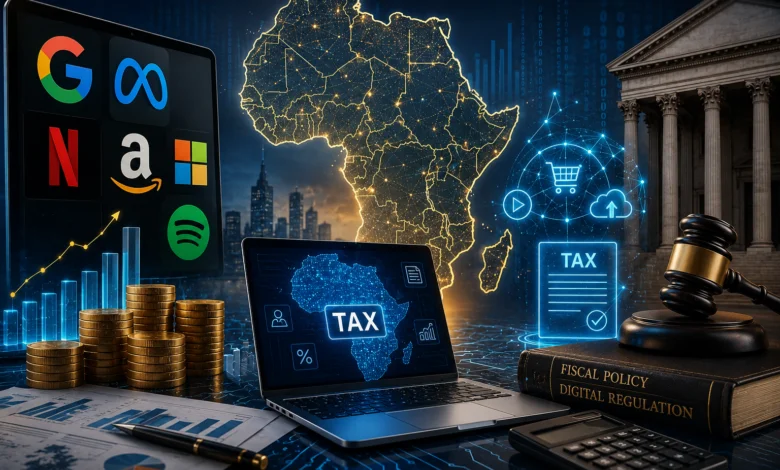
This regulatory framework is broad and intentional, encompassing entertainment services such as audio and video streaming, gaming, and interactive content, as well as targeted digital advertising, cloud infrastructure, Software as a Service (SaaS) services, application distribution platforms, and e-commerce. As such, the list of targets includes global technology giants like Google, Meta, Netflix, Amazon, Microsoft, and Spotify, which capture a significant share of digital consumption in Guinea without a corresponding tax burden.

By redirecting these revenues towards national technological development, the Guinean authorities are seeking to transform the tax into an instrument of digital industrial policy, rather than just a financial resource.
The tariff structure adopts a progressive approach, with the telecommunications services tax (RCN) ranging from 1.51 TP3T to 71 TP3T depending on the type of service. A 12-month transition period allows for the application of a uniform rate ranging from 11 TP3T to 31 TP3T. The decree also includes exemptions for educational and non-profit services, as well as companies with an annual revenue in Guinea of less than 250 million Guinean francs, with the aim of protecting small businesses and social enterprises from the tax burden.
This measure is not merely a traditional tax policy; it reflects a broader institutional transformation aimed at strengthening the country's digital sovereignty, improving oversight of digital flows, and mobilizing new resources to fund technological infrastructure, cybersecurity, training, and innovation. The Digital Sovereignty Fund is the cornerstone of this system, directing revenues toward supporting national technological development and transforming taxation into a tool of digital industrial policy.
Kenya as a reference model
Guinea is not starting from scratch, but rather joining an African path that began years ago, with Kenya being the most prominent and developed example. In 2021, Nairobi imposed a digital services tax of 1.5% on the revenues of foreign digital platforms operating without a local physical presence. The experiment proved its effectiveness, as the Kenya Revenue Authority collected 10.8 billion Kenyan shillings from the digital economy during the 2023-2024 fiscal year, with more than 350 taxpayers registered and compliant with the tax. In the 2022-2023 fiscal year, the proceeds amounted to 5.3 billion Kenyan shillings (about $37.5 million), achieving a growth of 207.9% compared to the previous year.
But Kenya continued to develop its model; in December 2024, it abolished the 1.5% digital services tax and replaced it with a large economic presence tax, which is levied at a rate of 30% on 20% of presumed profits generated from digital sales. This approach is based on linking the tax to the economic viability of platforms rather than the volume of sales, in line with international trends led by the OECD.
Preliminary results indicate a significant improvement, with Kenya collecting approximately 2.3 billion Kenyan shillings from 454 foreign digital service providers by August 2025, including 300 million shillings from the special digital services tax since its launch. Furthermore, effective July 2025, the minimum tax threshold was eliminated, meaning that any domestic revenue is sufficient for taxation.
The Kenyan path reflects a gradual evolution in African digital taxation, from simple pilot models to more sophisticated systems that comply with international standards and are ambitious in generating revenue.
A continent of diverse experiences
These transformations are not limited to Guinea and Kenya; the African continent is witnessing a broader wave of digital tax reforms, encompassing Nigeria, Senegal, South Africa, Cameroon, and others. Nigeria has introduced mechanisms to tax digital platforms as part of its recent reforms, while Senegal is considering expanding its digital value-added tax (VAT). South Africa has been applying VAT to foreign electronic services since 2014, making it one of the first countries on the continent to do so.
However, the African experience also reveals clear challenges. Uganda, after imposing a tax on social media in 2018, was later forced to amend it due to its impact on digital inclusion, highlighting the difficulty of balancing increased revenue with ensuring digital access in low-income economies.
Added to this is a complex technical challenge: tracking cross-border financial flows managed by companies with no physical presence. Countries rely on tools such as IP addresses, local payment methods, and phone numbers, but these remain limited by the complex tax structures of multinational digital companies.

A structural flaw in the global digital economy
Behind these policies lies a clear economic gap. In 2024, Africa received only 3% of global investments in data centers and registered only 18 projects in the field of financial technology, compared to 206 projects in developing Asian countries. This reflects the concentration of global digital value in a limited number of large companies, mostly in the United States and China, while their services are widely consumed in the African continent without a proportional return.
Africa’s digital infrastructure suffers from a severe lack of investment, as the continent needs about $61 billion annually to effectively connect developing countries to the internet, while only $15 billion was allocated in 2024. In this context, digital taxes stand out as a potential tool to self-finance digital development and reduce dependence on foreign aid.

United Nations officials confirm this trend, with Claver Gatete stressing that Africa should not remain merely a market for global platforms, but a beneficiary of added value, while Rebecca Greenspan calls for a fairer distribution of the returns of the global digital economy.
Between the global framework and national solutions
Under an international tax reform led by the OECD, through the “Two Pillars” agreement signed by more than 135 countries in 2021, this framework aims to redistribute part of the profits to the countries where economic activities are actually carried out, while imposing a global minimum tax rate of 15% on multinational companies.
However, the slow implementation has led a number of African countries to adopt independent national approaches. Kenya has partially amended its system to align with this framework, while Guinea is moving towards a more sovereign and independent approach to managing tax flows and generating domestic revenue.
These differences reflect two distinct visions: the first seeks integration into the global tax system, while the second tends to promote national sovereignty in the face of slow international reforms.
The question is no longer whether African countries will participate in taxing the digital economy, but rather in what form and with what share of the value generated by this huge digital market. Between national paths and the emerging international framework, a new struggle over digital sovereignty in the 21st century is taking shape, as African countries seek to establish their position in a global economic equation that is still taking shape.