An expert told Zoom Africa News: The receding Nile in Sudan is a warning sign of the dangers of unilateral operation of the Grand Ethiopian Renaissance Dam.
A sudden drop in the Blue Nile's flow raises water concerns in Sudan
Written by: Mohammed Omran
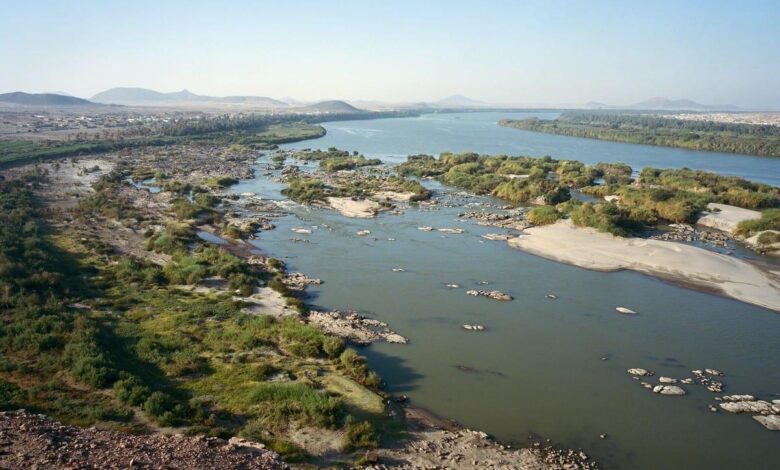
In a scene unfamiliar to Sudanese people at this time of year, vast areas of the riverbanks were exposed. NileSand formations appeared in the heart of the stream, while the water moved away from the intakes of a number of drinking water stations, so that within a few days the phenomenon turned from a remarkable sight into an issue that affects water and service security in the country.
An expert told Zoom Africa News: The receding Nile in Sudan is a warning sign of the dangers of unilateral operation of the Grand Ethiopian Renaissance Dam.
In this context, Dr. Mohamed Ezz El-Din, head of the Nile Foundation for African and Strategic Studies, said that the decrease in the level of the Blue Nile in Sudan during the period from July 7 to 9 represents a “warning bell” regarding the dangers of unilateral control over the operation of the Ethiopian Renaissance Dam, explaining that the decline in water discharges during that period revealed the extent of the effects that may result from managing the dam unilaterally without a binding agreement between the downstream countries and Ethiopia.

In exclusive statements to Zoom Africa News, Ezz El-Din added that what happened in a few days is a model of what the region may witness in the future if the unilateral operation of the Renaissance Dam continues, noting that Ethiopia reduced the discharges coming from the dam to the Blue Nile from about 207 million cubic meters per day to 129 million cubic meters, which led to a sharp decrease in water levels in Sudan.

He explained that this decline was directly reflected in a number of vital sectors, as some drinking water stations were affected, and the decrease in discharges led to a sudden shutdown of the turbines of the Roseires Dam, stressing that the impact was not limited to the course of the Blue Nile only, but extended to some rivers and waterways connected to it within Sudan.
The head of the Nile Foundation for African and Strategic Studies pointed out that it cannot be definitively stated that the region has entered a prolonged drought phase or that the current situation will continue for years, explaining that the Nile River has historically experienced natural cycles ranging between years of high flooding and years of low water levels, but that dam management and water flow control have become an influential factor that must be addressed.

Ezz El-Din stressed that the recent decrease in discharges represents a “rehearsal” for future scenarios that may occur if the absence of a legally binding agreement on the rules for operating the Renaissance Dam continues, warning that unilateral control of the Nile waters may create water crises for the downstream countries.
He called for the need to document what happened during July and to work on presenting its repercussions to regional and international institutions, including the African Union, the United Nations and the Security Council, in order to reach an agreement that ensures the operation of the Renaissance Dam in a way that takes into account the interests of all parties.

He added that the 2026 flood season has not yet fully begun, and that it is too early to assess the size of the flood or to consider it an indicator of entering a drought phase, but he stressed the need to prepare for all future scenarios, especially in light of the possibility of lower flood rates in some years.