Niger and Mauritania affirm their commitment to strengthening security coordination to address the challenges facing the Sahel.
A Mauritanian envoy carries a message from President Ghazouani to President Chiani
Written by: Mohamed Ragab
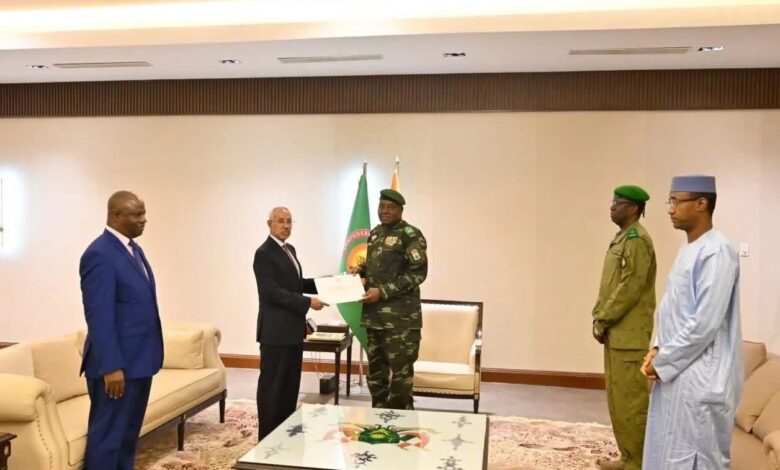
The President of the Republic of Niger, General Abdourahmane Tchiani, received the Minister of Defense, Retirees and Sons of Martyrs of the Islamic Republic of Mauritania, Hanena Ould Sidi, who visited Niamey as a special envoy of Mauritanian President Mohamed Ould Cheikh Ghazouani, in a move that reflects the two countries’ keenness to strengthen consultation and coordination on bilateral and regional issues of common interest.
During the meeting, the Mauritanian envoy delivered a written message from President Ghazouani to his Nigerien counterpart, which included his wishes for the Nigerien people to achieve further progress, prosperity and stability, and reflected Mauritania’s desire to continue strengthening relations with Niger in various fields.
Praise for bilateral relations between Niamey and Nouakchott
The talks addressed ways to develop bilateral relations between the two countries, with both sides praising the level of cooperation between Niamey and Nouakchott, and emphasizing the depth of the historical and fraternal ties that unite the two peoples.
During the meeting, officials stressed the importance of strengthening the bilateral partnership in the political, security and economic fields, and working to expand the horizons of cooperation in a way that serves the common interests of the two countries and contributes to supporting development and stability efforts.
Observers believe that relations between Niger and Mauritania have witnessed remarkable development in recent years in a number of areas, especially those related to regional security and cooperation in facing the common challenges facing the Sahel region.
Security and stability top the agenda of the talks
Security and regional issues occupied an important part of the discussions, in light of the continuing challenges facing the Sahel region of Africa, including threats from armed groups, transnational crime networks, and humanitarian challenges related to displacement and instability.
Both sides stressed the need to continue coordination and consultation among the countries of the region in order to enhance security and stability, emphasizing that confronting security challenges requires close cooperation and exchange of information and expertise among the countries concerned.
Both sides also stressed the importance of adopting common approaches to address regional crises, in order to contribute to achieving stability and creating favorable conditions for economic and social development in the Sahel countries.
The Sahel region faces increasing challenges
The Sahel region is one of the African regions most affected by security challenges in recent years, as many countries face escalating threats stemming from the activity of armed groups and the repercussions of economic and humanitarian crises.
In this context, cooperation between the countries of the region is highlighted as one of the fundamental pillars for dealing with these challenges, and for enhancing the ability of governments to protect their borders and maintain their internal stability.
Exchange of messages to strengthen the partnership
At the end of the meeting, President Abdourahmane Chiani entrusted the Mauritanian envoy with a fraternal message to President Mohamed Ould Cheikh Ghazouani, wishing him success in his duties.