Egypt's ambassador to Guinea receives the former president of the Guinean Students' Union in Cairo
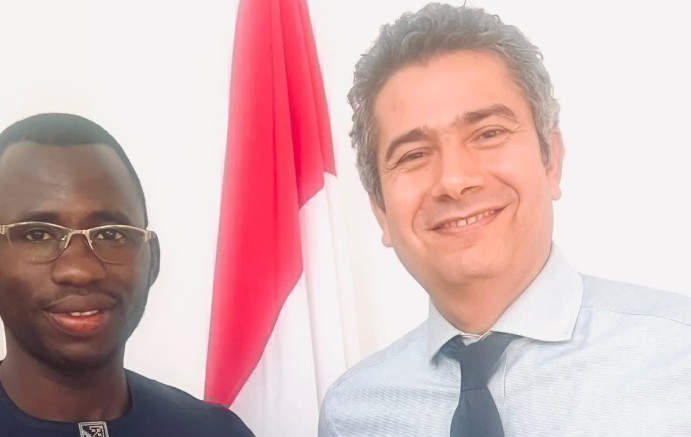
Written by Ziad Abdel Fattah:
Ambassador Mohamed El-Halawany, Egypt’s ambassador to the Republic of Guinea, received the former president of the Guinean Students Union in Cairo, while the former president of the Guinean Students Union in Cairo presented the ambassador with the latest issue of their annual magazine published in Cairo.
According to the ambassador, via his personal Facebook page, students from sisterly Guinea have been studying in Egypt for hundreds of years in the halls of Al-Azhar Al-Sharif and in various universities, institutes and schools.
2000 Guinean students in Cairo
The number of Guinean students in Cairo is about 2000 male and female students, who represent bridges of friendship and brotherhood between the two countries for a long time and for many years to come.
Guinea is located on the west coast of Africa, overlooking the Atlantic Ocean to the west. It consists of 4 natural regions: Lower or Coastal Guinea, Middle Guinea, Upper Guinea and Forest Guinea. It is sometimes called Guinea-Conakry to distinguish it from its neighbor Guinea-Bissau. The country is divided into 8 administrative regions, which in turn are divided into 33 provinces.
Historical relationship between Egypt and Guinea
The relationship between Egypt and Guinea is a historical one, dating back to Guinea's independence from France in October 1958. This was embodied in the strong friendship that united the two historical leaders, Gamal Abdel Nasser and Ahmed Sékou Touré, since then. Egypt has been keen to support Guinean cadres through training courses organized by the Egyptian Fund for Technical Cooperation with Africa, in coordination with various governmental bodies, in many fields such as health, the judiciary, the police, agriculture, education, and training of diplomats.
The development of economic relations between the two countries occupies a large part of the discussions, and the transition to a stage that establishes more distinguished prospects in the level of the strategic relationship between the two countries.
Egypt's exports consist mainly of foodstuffs, manufactured iron and steel building materials, electrical cables, and pipes and tubes used for gas, while Guinean exports to Egypt are non-existent except for liquefied natural gas.
Many businessmen visited Conakry, the capital of Guinea, and agreed that the Guinean market has the capacity to absorb Egyptian investments and products.