Africa NewsSlider

Following attacks on his citizens, the Nigerian president refuses to meet with an envoy from his South African counterpart.

Written by: Ayman Ragab

On Monday, Nigerian President Bola Tinubo refused to meet with a special delegation sent by South African President Cyril Ramaphosa to discuss ongoing xenophobic attacks targeting Nigerians in South Africa, and instead directed the visiting delegation to meet with the Minister of State for Foreign Affairs, Ambassador Sola Enekanolay.

Informed presidential sources confirmed to Punch Online that the delegation, headed by South African Minister of International Relations and Cooperation Ronald Lamola, requested a meeting with the president upon his arrival in Abuja on Friday.

However, Tinubu directed the delegation to meet with Enekanolaye, who took over as Minister of State for Foreign Affairs in June 2026, following the promotion of Ambassador Bianca Odumejo-Ojukwu to the position of Minister of Foreign Affairs, after the departure of Yusuf Tugar.

This development comes amid diplomatic tensions between Nigeria and South Africa over renewed xenophobic attacks targeting Nigerians and other African nationals, forcing some 600 Nigerians to return home.

A presidential source said: “They arrived on Friday and wanted to meet the president, but there was no prior notification. We informed them that the meeting could not be arranged without the president’s approval. When we asked him, he agreed that the meeting would be on Monday.”

Recommendation not to receive the delegation by the president 

He added: “But when Monday came, the President decided that they should meet with the Minister of State for Foreign Affairs, Ambassador Enikanolayi, with the understanding that the Minister would later inform him of the results of the meeting.”

A second presidential source confirmed the decision, saying: “It’s just been confirmed, the president will not meet with them, and the meeting will not take place.”

A third presidential official said: “This meeting is not on today’s agenda.”

According to reports, the South African delegation remained in Abuja throughout the weekend after arriving on July 24, carrying a message from President Ramaphosa.

Other sources revealed that the Foreign Minister, Ambassador Bianca Odumejo-Ojukwu, who is on an official mission in Addis Ababa, recommended that the President not receive the delegation in light of the continued attacks on Nigerians and their property in South Africa.

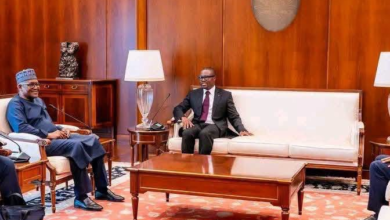
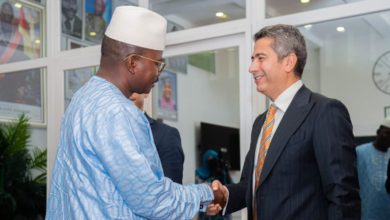
During his meeting with the delegation in Abuja, Enekanolayi explained that President Tinubu had tasked him with conducting consultations with the envoys to find a solution to the crisis, stressing the need to prevent attacks on African migrants from damaging the historical relations between Nigeria and South Africa.

He said: “I am pleased to welcome our brothers from South Africa. President Bola Ahmad Tinubu has tasked us with meeting with you and exchanging views on ways to address and end the ongoing attacks against Africans in South Africa, of which Nigerians and other citizens of the continent have been among the most prominent victims.”

The minister expressed his regret over the repeated attacks on Nigerians, noting that these incidents have been recurring for decades.

He said: “We have observed a recurring pattern of these attacks in the years 1995, 1998, 2006, 2015, 2016, 2019, 2021, 2024 and 2026. Records indicate that since 2022 alone, 98 Nigerians have been killed in mob violence and hate crimes, a phenomenon we have termed ”Africanophobia,’ because its main victims are Africans, and Nigerians in particular.”

Enekanolayi pointed to the historic role Nigeria played in supporting South Africa’s struggle against apartheid, stressing that the current acts of violence are inconsistent with the nature of the relationship between the two countries.

Nigeria does not defend crime.

He stressed that Nigeria does not defend crime, but demands that any accused person be subject to due process, not mob violence.

He said: “If someone is accused of drug trafficking, there are laws and procedures that govern their arrest, trial, and imprisonment. The Nigerian government does not support drug traffickers, but it demands that they be treated in accordance with your constitution, international human rights conventions, and minimum humanitarian standards.”

President of South Africa

He added: “But what we have noticed is that these attacks are no longer targeting criminals only, but have also affected Nigerians who reside legally in South Africa, yet they have been attacked.”

He continued: “We witnessed riots during which the police stood by as if they were powerless to intervene, which raises questions about the responsibility of the state, and even raises questions about the possibility of collusion. If the state authorities are unable or unwilling to confront these challenges, then this is a matter of grave concern.”

The minister described the humanitarian impact of the attacks as “devastating,” recalling the evacuation of some 1,500 Nigerians from South Africa.

He said: “The last batch we brought home included about 1,500 citizens. It was a very painful experience. I cried on the plane when I saw children, women, and the elderly returning to their country with almost nothing, after their property had been looted or destroyed.”

For his part, South Africa’s Minister of International Relations and Cooperation, Ronald Lamola, explained that President Ramaphosa had sent him as a special envoy to convey a message to President Tunpu, and to reiterate South Africa’s rejection of xenophobia and all forms of intolerance.

He said: “We have been clear in our rejection of all forms of intolerance, including xenophobia, racism, homophobia, violence and discrimination against anyone within the borders of South Africa.”

Enforcing immigration laws and combating criminal activities

But he stressed at the same time that his country would continue to enforce immigration laws and combat criminal activities.

He added: “President Ramaphosa was firm in asserting South Africa’s sovereign right to enforce immigration laws, including combating irregular migration and dealing firmly with illegal immigrants, as well as confronting crimes committed within our borders.”

Lamola stressed that migration is a continent-wide challenge and requires collective cooperation.

He said: “We believe that Nigeria and South Africa share a common responsibility in addressing the challenges of migration within Africa. It is an issue that affects the entire continent, and we must work together to address it.”

He expressed confidence that the Abuja meeting would contribute to strengthening bilateral cooperation and open the way for addressing the crisis through continued dialogue.

protests
protests

Relations between Nigeria and South Africa have deteriorated significantly in recent weeks, following a wave of xenophobic violence that erupted in April 2026 in several South African provinces.

The crisis led President Tinubu to approve five evacuation flights operated by Air Peace, after more than a thousand Nigerians registered for voluntary repatriation. Nigeria also threatened diplomatic countermeasures, with the House of Representatives recommending the suspension of licenses for South African companies operating in Nigeria, and the Senate dispatching a delegation to Pretoria to express the country's displeasure.

Punch Online reported that Lamola’s visit was aimed at containing the tension through direct communication with the Nigerian presidency, before the African Union’s extraordinary summit on conflict prevention and resolution, scheduled to be held in Angola from August 29 to 30, 2026.

Related Articles

Leave a Reply

Your email address will not be published. Required fields are marked *

Back to top button