A historic decline in the Nile's water level in Sudan... What is the connection to the Grand Ethiopian Renaissance Dam?
A sudden drop in the flow of the Blue Nile disrupts drinking water stations.
Written by: Mohammed Omran
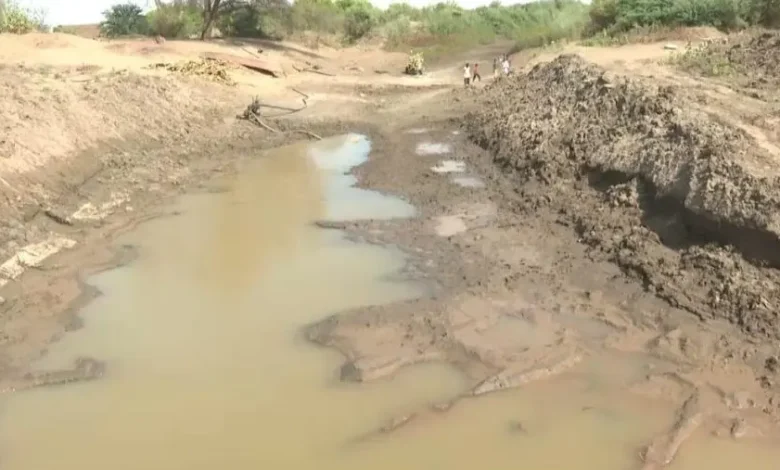
In a scene unfamiliar to Sudanese people at this time of year, vast areas of the riverbanks were exposed. Nile RiverSand formations appeared in the heart of the stream, while the water moved away from the intakes of a number of drinking water stations, so that within a few days the phenomenon turned from a remarkable sight into an issue that affects water and service security in the country.
A historic decline in the Nile's water levels in Sudan... Has the Grand Ethiopian Renaissance Dam begun to change the rules of the game?
While Sudanese people usually expect the Nile levels to gradually rise as the flood season approaches, several stations this year recorded a decrease in levels, which affected the operation of a number of drinking water stations and some irrigation projects, especially in the capital, Khartoum.
Despite assurances from the Sudanese Ministry of Agriculture and Irrigation that the overall water situation remains stable and that the decrease is temporary, the phenomenon has brought back to the forefront the debate about the effects of the continued operation of the Ethiopian Renaissance Dam on the hydrological system of the Blue Nile.
The ministry attributed the decrease observed during the period from July 7 to 9 to a decline in discharges from the Blue Nile, as a result of the decrease in the quantities of water released from the Ethiopian Renaissance Dam during that period.
The ministry said in a press statement yesterday that this decline led to a decrease in discharges from the Roseires and Sennar reservoirs, before it was reflected in the river levels at a number of stations located along the course of the Nile.
The statement explained that the daily inflow to the Roseires Reservoir Lake temporarily decreased during the period from July 7 to 9, 2026, from 207 million cubic meters per day to 129 million cubic meters, a decrease of 76 million cubic meters.
At the same time, the ministry stressed that the overall picture does not reflect a comprehensive water crisis, noting that the White Nile is recording higher revenues than its usual rates.

Drinking water stations were among the first sectors affected by the drop in water levels, as the water level in Khartoum State dropped to the point where the river flow was far from the pump inlets in some stations, leading to the shutdown of major stations and a decrease in the production of others, and this was reflected in the water supply in a number of densely populated neighborhoods.
The Khartoum State Water Authority announced that the “Al-Salha Water” and ”North Bahri” stations have been temporarily taken out of service due to the waterway being far from the suction pumps, noting that excavators have been used to dig new waterways.
The authority explained in a press release that it implemented urgent treatments that included removing sediment and digging new channels, in addition to studying permanent solutions, including modifying the locations of intakes and creating alternative sources of supply.
A change in the river's behavior
Sudanese water resources expert, Engineer Mohamed Ali Suleiman, told Xinhua News Agency that what Sudan is witnessing is a result of the transformation that has occurred in the flow system of the Blue Nile after the Renaissance Dam entered the stage of full operation.
Suleiman explained that the river no longer behaves according to its natural rhythm that Sudan has been accustomed to for decades, as the quantities of water and the timing of its arrival have become largely linked to the operating programs of the Ethiopian dam.
He added that in previous years the impact was not clearly visible due to the exceptional increase in White Nile revenues, which helped to offset a large part of the decline in Blue Nile imports. However, the decrease in the White Nile's contribution this year, coinciding with the decline in Blue Nile discharges, revealed the extent of the change in an unprecedented manner.
He pointed out that the problem lies not only in the lack of water, but also in the sudden fluctuations in water levels, which makes it difficult for dam and water station operators to plan ahead to manage water resources efficiently.
For his part, Professor of Water Resources Engineering in Sudan, Abdul Rahim Talab, told Xinhua that one of the most prominent challenges is the lack of daily data exchange regarding the operation of the Renaissance Dam.
Talab explained that managing any shared river system requires prior knowledge of the expected discharge volumes, so that downstream countries can control the operation of local dams and manage water stations and irrigation projects.
He added that the lack of information makes Sudanese authorities deal with changes after they occur instead of preparing for them in advance, which increases the cost of technical solutions and affects the stability of services.
He noted that current changes underscore the need to develop early warning and hydrological monitoring systems.
Economic and agricultural repercussions
The effects of the low Nile levels were not limited to drinking water, as they extended to the agricultural sector, where some irrigation stations faced difficulty in operating the pumps as a result of the water moving away from their intakes.
Experts have warned that continued fluctuations in the Nile's water levels could impose additional financial burdens on irrigation projects, whether through infrastructure modifications or increased operating and maintenance costs.
Water expert Abdul Qader Abdoun said that dealing with these changes requires a long-term vision that goes beyond emergency solutions.
Abdoun suggested redesigning water station intakes to accommodate fluctuations in water levels, increasing reliance on groundwater wells as a backup source in major cities, developing real-time monitoring systems for water levels and discharges, and updating the operating rules for Sudanese dams to keep pace with new changes.
Abdoun believes that what happened during July may be an indication of a new phase in water resource management in Sudan, where the challenges are no longer related only to the volume of available water, but also to the speed of change in water levels and the irregularity of flows.
While Sudanese authorities assert that the current situation does not threaten the country's water security, experts believe the phenomenon represents a test of Sudan's ability to adapt to the changes imposed by the Renaissance Dam.
The current controversy over the decline in Nile levels comes amid the ongoing dispute between Sudan, Egypt and Ethiopia over the rules for operating the Grand Ethiopian Renaissance Dam (GERD), since the signing of the “Declaration of Principles” in Khartoum in 2015, which stipulated cooperation, non-harm to downstream countries and coordination in filling and operating the dam.
In September 2025, Ethiopia announced that the dam had entered the stage of full operation, while Khartoum and Cairo continue to demand a binding mechanism for data exchange and coordination regarding its operation, in order to avoid sudden fluctuations in water flows.
The design capacity of the Renaissance Dam is 74 billion cubic meters, while the amount of water currently stored is estimated at about 42 billion cubic meters.