Violations against civilians: Will Congo succeed in convicting Rwanda before the International Court of Justice?
It demands that Rwanda be compelled to cease the alleged violations and compensate the victims.
Written by: Mohammed Omran
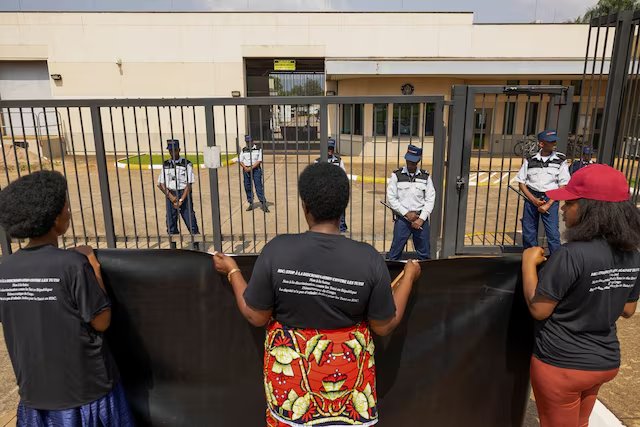
In a new legal move reflecting escalating tensions between the two countries, the Republic of Congo The Democratic Party has taken the dispute with Rwanda to the halls of international justice, after filing a lawsuit before the International Court of Justice accusing Kigali of committing serious violations of international law and supporting armed groups active in eastern Congo. This step comes amid continued violence and instability in the region, amid demands to hold accountable those responsible for violations against civilians over decades.
Will Congo succeed in convicting Rwanda before the International Court of Justice?
The Democratic Republic of Congo has filed a lawsuit with the International Court of Justice against Rwanda, accusing it of involvement in the ongoing conflict in the east of the country and of violating a number of international agreements, including agreements on the prevention of genocide, the elimination of racial discrimination and against torture.

The Congolese government said in a statement issued Friday that Rwanda had sent troops and provided support or guidance to armed groups that had carried out illegal military operations inside Congolese territory since the aftermath of the 1994 Rwandan genocide.
It demands that Rwanda be compelled to cease the alleged violations and compensate the victims.
She added that the alleged violations against civilians included massacres, extrajudicial killings, torture, sexual violence, forced displacement and discrimination, stressing that these practices have continued for more than three decades.
The Rwandan government did not immediately comment on the lawsuit, while Kigali has consistently denied accusations that it supports rebel groups operating in eastern Congo.
Congo asked the court to compel Rwanda to stop what it described as ongoing violations, as well as to pay compensation to the Congolese state and to the victims of the conflict.

The International Court of Justice, the highest judicial body of the United Nations for settling disputes between states, confirmed that it had received the request submitted by Congo to initiate legal proceedings.
United Nations experts and several Western governments have accused Rwanda of providing support to the armed "March 23 Movement," one of the most prominent groups active in eastern Congo, an accusation Rwanda consistently denies.

The conflict has its roots in the aftermath of the 1994 Rwandan genocide, when elements of the forces and militias associated with the genocide fled to eastern Congo, contributing to the escalation of armed conflicts in the region.
This is the third attempt by Congo to sue Rwanda before the International Court of Justice; the first case was withdrawn in 2001, while the court refused to consider the second case in 2006 due to a lack of jurisdiction at the time.