Written by: Mohammed Omran
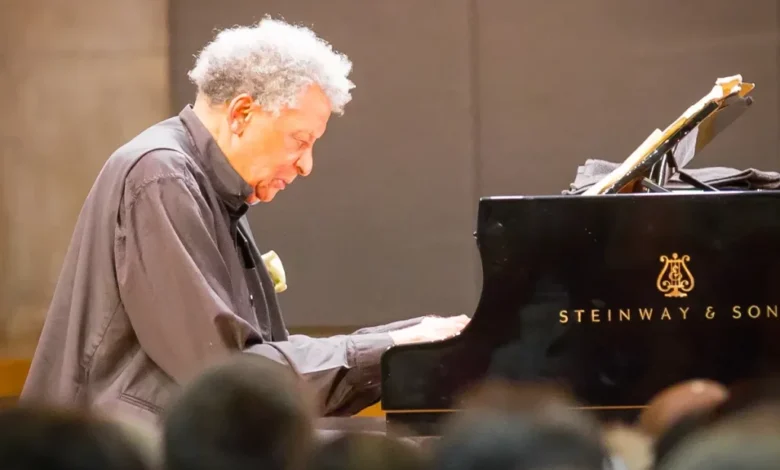
Abdullah Ibrahim is one of the most prominent figures in jazz music in the world, as his artistic imprint formed a unique voice that transcended continental boundaries, and made the rhythms of soul and African jazz a universal language that reflects issues of freedom and resistance.
The passing of the pianist who immortalized the music of the African struggle
From Cape Town to New York, passing through Zurich and Paris, the late South African pianist, who died at the age of 91, built an artistic career that spanned more than seventy years, during which he left a musical legacy closely linked to the struggle against the apartheid regime in South Africa.
Discovered by world-renowned jazz leader Duke Ellington in the early 1960s, Ibrahim's exceptional talent immediately caught the eye, before Nelson Mandela later described him as "the Mozart of our time." Between these two accolades, Ibrahim cemented his place as one of the most influential musicians in jazz history, transforming Cape Town rhythms into a universal musical discourse that carries messages of freedom and identity.
Abdullah Ibrahim, whose original name was Adolf Johannes Brand, was born on October 9, 1934, in the Kensington neighborhood of Cape Town. He grew up in a musical environment that influenced his early development, as his mother and grandmother were singers in the church, and he was introduced to the piano at the age of seven by his grandmother.
From his childhood, he was influenced by Marabe music and the works of Duke Ellington and Thelonious Monk, which reached South Africa via sailors.
At an early age, he began his professional career, rising to prominence in the 1950s under the name “Dollar Brand”, before co-founding the Jazz Epistle band alongside a number of South Africa’s most prominent musicians. Their 1960 album, “Jazz Epistle Verse One”, achieved a historic milestone as the first jazz record released by black musicians in the country.
As the political situation in South Africa deteriorated following the Sharpeville massacre, a large number of artists were forced to leave the country, which is what happened to Ibrahim, who settled in Europe in 1962. There, his meeting with Duke Ellington marked a major turning point in his career, opening the doors to international recognition for him, allowing him to produce works that achieved widespread success in the international music scene.
In 1968, he announced his conversion to Islam, taking the name Abdullah Ibrahim, in a move that reflected a spiritual and artistic transformation in his career, as his music became more associated with African sounds and the spiritual dimension, which later formed his distinctive artistic identity.
His famous piece “Mannenberg,” released in 1974 in collaboration with saxophonist Basil Coetzee, is one of his most prominent works, as it became an unofficial anthem of resistance against the apartheid regime and became associated with the memory of the popular struggle in South Africa.
The late leader Nelson Mandela called him ”the Mozart of our time,” and Ibrahim participated in the official celebrations of Mandela’s inauguration as President of South Africa in 1994, confirming his symbolic status in the country’s history.
During his career, Ibrahim recorded more than seventy albums, collaborated with world-renowned jazz musicians such as John Coltrane, Max Roach and Ornit Coleman, and founded the band “Ikaya”, which performed on the most prominent international stages.
His contributions were not limited to jazz; he also composed film scores, participating in notable works with director Claire Denis and director Idrissa Ouédraogo.
Ibrahim has received numerous international honors, including the Ikamanga Silver Medal from South Africa in 2009, an honorary doctorate from the University of the Witwatersrand, and the title of “Master of Jazz” from the National Endowment for the Arts in the United States in 2019.
Despite his advanced age, Ibrahim remained present on the artistic scene until his later years, continuing to perform musical shows. His last public appearance was at the Cape Town International Jazz Festival last March.
His family announced his death on June 15, 2026 in Germany, where he lived, noting that he passed away peacefully after a life full of giving, leaving behind a musical and humanitarian legacy that transcends borders.
Between his music and his stances, Abdullah Ibrahim remains one of the most prominent artists who succeeded in transforming jazz into a universal language, bringing together Africa and America, art and freedom, and memory and hope.