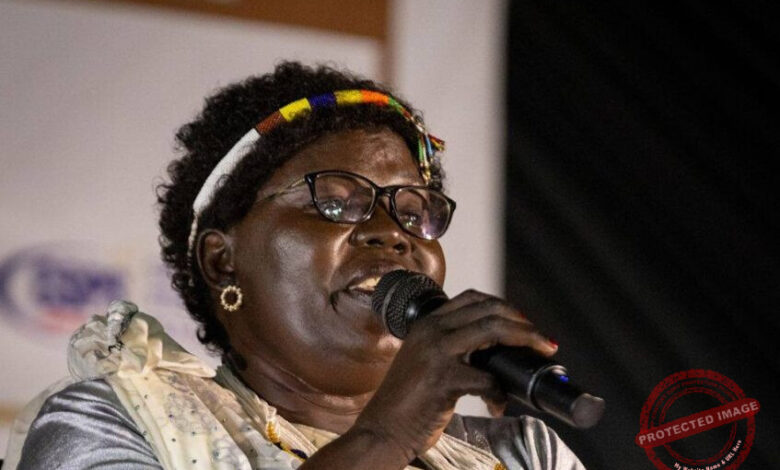
Sadness has enveloped the artistic and cultural circles in South Sudan. SudanFollowing the announcement of the death of prominent singer Vivian Nyashan, who passed away in the capital Juba after a successful artistic career dedicated to spreading the values of love and social cohesion.
Sudden death in the capital, Juba
The family of the late artist, whose full name is Vivian James Chuai, announced her death at the Gori Medical Clinic on Tuesday evening, following a short battle with illness.
The family described the passing of Niashan, who was in her early sixties, as a “shocking surprise” to her fans and colleagues in the art world, noting that funeral and burial arrangements would be announced later.
A busy journey
Nyashan was born in 1965 in Malakal, Upper Nile State, and grew up in a family with a long tradition of artistic talent, influenced by her uncle who was a famous artist in the Shilluk tribe (Collo).
Her talent began to emerge in childhood through singing church hymns, before she officially began her professional career in 1992.
Nyashan became famous under the title “Queen of Malakal” and for her outstanding ability to sing in four local languages, most notably her mother tongue “Shilluk” and Arabic, which made her a “spiritual mother” to young artists and a bridge connecting different musical generations in South Sudan.
A voice of peace amidst the winds of conflict
Vivienne was not just a singer, but an “icon of peace”; her voice was associated with calls for restraint and the protection of civilians during periods of civil war.
Her famous song “Look at me” is a widely popular humanitarian anthem calling for the protection of women, children, and farmers and sparing them the horrors of conflict.
Her music has successfully transcended geographical boundaries, reaching a wide audience in the diaspora through social media platforms and the internet, with timeless works such as the album “Wadakona” and the songs “Amara”, ”Raj Bini”, and ”Hakuma Ta Mara”.
The voice of marginalized communities has departed
As soon as the news broke, social media platforms were flooded with tributes from fans and fellow musicians, who described the deceased as a “powerful and moving voice” that expressed the conscience of communities across the country.
Despite the great challenges she faced during her career due to the circumstances of the conflict, Nishan remained committed to her artistic message until her last breath, believing that art is the ultimate way to spread joy throughout her country.