Germany offers a €200 million grant to South Africa for investment in vital minerals.
What are the main features of the new climate loan that Germany has provided to South Africa?
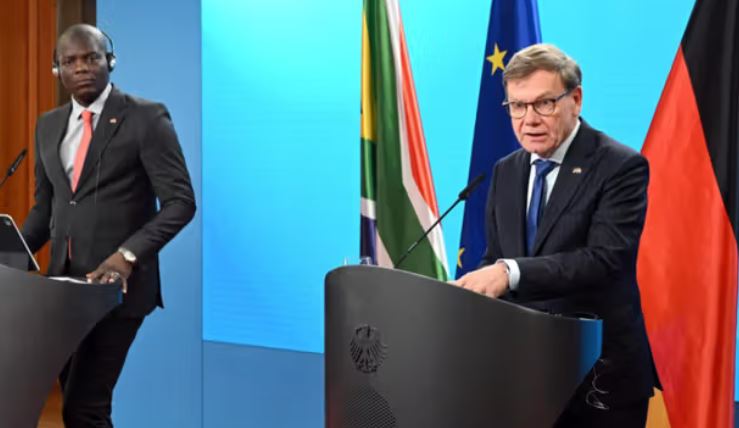
In a significant economic move, German authorities have agreed to grant South Africa a new climate loan of 200 million euros, as announced by South African Foreign Minister Ronald Lamola.
How will the 200 million euros be used to support the electricity grid and renewable energy?
The grant from Germany to South Africa came on favorable terms worth 200 million euros, equivalent to 234 million US dollars, and the two countries will work to enhance cooperation in other areas, such as vital minerals, according to Reuters.
South African Minister Ronald Lamola said, following talks with his German counterpart Johann Wadephul in Berlin, that the loan would support investment in South Africa's electricity grid and renewable energy capacity.
Lamola added that German and EU funding for green hydrogen and cooperation in the battery value chain has also been extended by more than 270 million euros.
At the end of the press conference, Lamola and Adefol thanked Germany for its support despite strained relations between South Africa and the United States during President Donald Trump's second term.
On the international level, Germany and South Africa have taken diplomatic action to push for a resumption of the stalled negotiations, warning of serious global repercussions should the temporary truce collapse.
This came during a high-level meeting in Berlin as part of the twelfth session of the German-South African Bilateral Committee, where the two countries’ foreign ministers stressed that the diplomatic path remains the only option capable of preventing the region from sliding into open confrontation.
German Foreign Minister Johan Wadephul stressed that continuing negotiations is "of paramount importance," noting that the existing ceasefire should be used as a window of opportunity to avoid escalation.
For his part, South African Foreign Minister Ronald Lamola stressed his country’s position rejecting any military escalation, considering the collapse of the negotiating track to be a «missed opportunity» that could have led to a settlement soon.