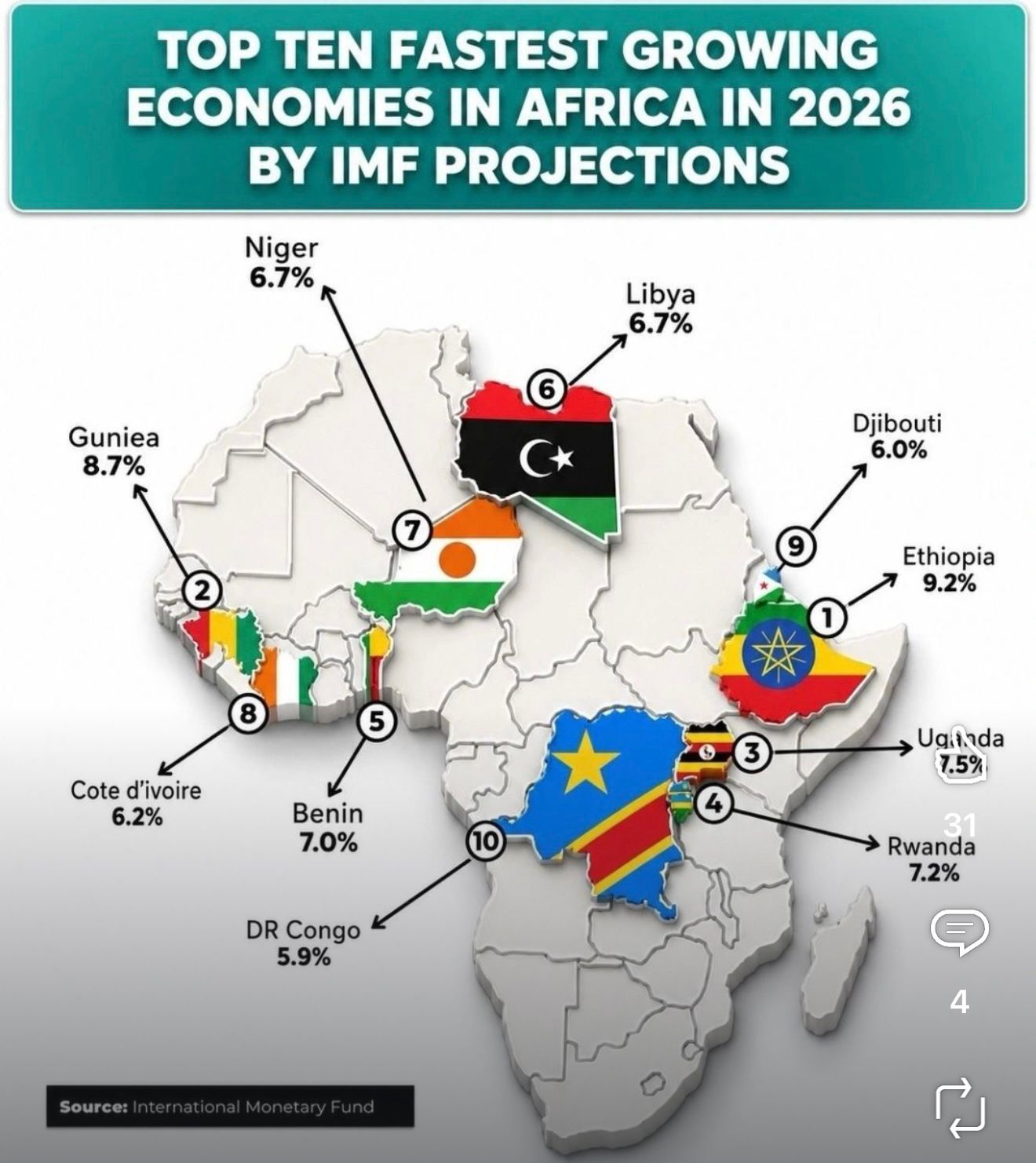
The 10 fastest-growing African economies in 2026

Ahmed Salem
Many African economies are expected to maintain strong growth in 2026, with countries projected to expand at rates significantly higher than the global average.
According to the data International Monetary FundAfrican economies are expected to register growth rates between 5.9% and 9.2% in 2026, which is far above the global average growth rate.
The ranking is based on projections contained in the International Monetary Fund's World Economic Outlook report issued in April 2026, which provides updated estimates of economic growth across the continent.
The fastest-growing African economies in 2026
The following is a ranking of the fastest-growing African economies in 2026, according to data from the International Monetary Fund, presented in descending order:
10. Democratic Republic of Congo (5.9%)
The Democratic Republic of Congo is expected to register economic growth of 5.9% in 2026, a slight increase from 5.7% in 2025.
The country's growth continues to be supported by its large mining sector, particularly the production of copper and cobalt, which are key minerals for the global energy transition. The Democratic Republic of Congo has become one of the world's leading suppliers of battery minerals, contributing to sustained export revenues and investment flows.
9. Djibouti (6.0%)
Djibouti’s economy is projected to grow by 6.0% in 2026, in line with the growth rate expected for 2025, according to IMF data.
The country's strategic location along one of the world's busiest shipping routes continues to support economic activity. Investments in logistics infrastructure, ports, and transport services remain key drivers of growth, as Djibouti strengthens its position as a regional trade hub.
8. Ivory Coast (6.2%)
The Ivory Coast economy is expected to grow by 6.2% in 2026, slightly less than the 6.5% projected for 2025.
Despite a slight slowdown, Côte d'Ivoire remains one of the strongest performing economies in West Africa. Growth is supported by the agriculture, industry, and construction sectors, as well as ongoing investments in public infrastructure. Côte d'Ivoire also remains the world's largest cocoa producer, providing a strong export base.
7. Niger (6.7%)
According to IMF data, Niger is projected to grow by 6.7% in 2026, slightly less than the 6.9% forecast for 2025.
The country's economy continues to benefit from investments in the extractive sector, particularly oil production. New energy projects and infrastructure development are expected to contribute to economic activity despite ongoing political and security challenges.
6. Libya (6.7%)
The Libyan economy is expected to grow by 6.7% in 2026, following an exceptional growth rate of 15.9% that was projected for 2025.
This decline reflects a return to normalcy after a strong recovery largely driven by oil production. However, Libya remains among the fastest-growing economies in Africa due to the continued importance of its hydrocarbon sector and improved oil production compared to previous years.
5. Benin (7.0%)
Benin is projected to achieve economic growth of 7.0% in 2026, compared to 7.5% in 2025.
The country has emerged as one of the most stable and growing economies in West Africa in recent years. Government reforms, infrastructure development, agricultural expansion, and increased business activity continue to support economic growth.
4. Rwanda (7.2%)
In fourth place is the Rwandan economy, which is expected to grow by 7.2% in 2026, up from 7.0% in 2025.
East Africa's economy continues to benefit from investments in the services, tourism, technology, and infrastructure sectors. Rwanda's focus on improving its business environment and attracting foreign investment has contributed to maintaining strong economic performance over the past decade.
3. Uganda (7.5%)
The IMF projects that Uganda’s economy will grow by 7.5% in 2026, a significant increase compared to 6.7% in 2025.
Growth is supported by massive investments linked to the country's nascent oil industry, along with expansion in agriculture, industry, and services. Large-scale infrastructure projects related to energy development are also expected to contribute to economic activity.
2. Guinea (8.7%)
Guinea is expected to record economic growth of 8.7% in 2026, a sharp increase from 6.7% in 2025.
The country's strong performance is closely linked to the mining sector, particularly bauxite production. Guinea possesses some of the world's largest bauxite reserves, making it a key supplier to the global aluminum industry. Continued investment in the mining sector is expected to support growth in the medium term.
1. Ethiopia (9.2%)
Ethiopia tops the rankings with an expected economic growth rate of 9.2% in 2026, the same rate recorded in 2025.