Central Equatoria investigates Ugandan incursions into Kajo-Keji and approves projects to support development and culture.
The state government confirms coordination with Juba to contain border tensions.
Written by: Mohamed Ragab
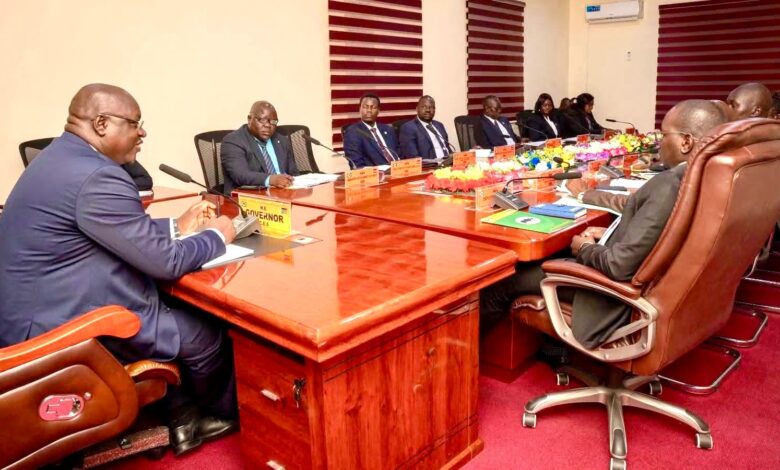
The Council of Ministers of Central Equatoria State in South Sudan discussed security developments on the border with Uganda, affirming the state government’s commitment to working jointly with the national government to address the repeated incursions of the Ugandan People’s Defence Forces (UPDF) into the territory of Kajo-Keji County, and to work to contain tensions and restore stability to the border areas.
This came during the council’s regular meeting, chaired by the state governor, Emmanuel Adil Anthony, where ministers reviewed the security developments in Kajo Keji following the recent clashes between the South Sudan People’s Defence Forces (SSPDF) and Ugandan forces, which raised concerns about escalating tensions on the shared border between the two countries.
Joint actions with the central government
The Cabinet affirmed that the state government is coordinating directly with the national government in Juba to make contact with the Ugandan authorities, with the aim of addressing the situation on the ground and preventing any new escalation that may affect the security of the population or the stability of the border areas.
The Council stressed the importance of adopting dialogue and security coordination between the two countries to address border incidents, calling for urgent and effective measures to ensure the return of calm and to maintain bilateral relations based on good neighborliness and joint cooperation.
Officials noted that stability in border areas is a priority for the government, given its direct impact on the movement of citizens, trade, and economic activities between South Sudan and Uganda.
Establishing an Institute for Cooperation and Rural Development
On the development side, the Cabinet approved a memorandum submitted by the Minister of Cooperation and Rural Development, Emmanuel Khamis, regarding the establishment of the Institute of Cooperation and Rural Development, with instructions to the relevant authorities to allocate a plot of land for the establishment of the project.
The institute aims to enhance the capabilities of cooperative societies and agricultural groups, provide training programs in management and rural development, conduct research and support innovation, contributing to the development of policies related to economic development and improving the level of agricultural production in the state.
The government also hopes that the institute will become a platform for training local personnel and supporting initiatives aimed at achieving economic recovery and creating new job opportunities, especially in rural areas.
New Commission for Arts, Culture and Heritage
After introducing amendments, the Council approved the memorandum of the Minister of Culture, Youth and Sports, Bush Busi, regarding the establishment of the Arts, Culture and Heritage Commission, which will be responsible for organizing and developing the cultural sector, protecting local heritage, and encouraging cultural and artistic production that reflects national identity and societal values.
The commission is expected to play an important role in supporting artists and cultural institutions, preserving the cultural heritage of Central Equatoria State, and promoting youth participation in cultural and creative activities.
Guidelines for implementing decisions
At the conclusion of the meeting, the Cabinet directed the Ministries of Cooperation and Rural Development, Culture, Youth and Sports, and Finance, Planning and Investment to quickly take the necessary executive measures to implement the approved decisions, ensuring the achievement of their objectives in supporting development and promoting stability.
These decisions come at a time when Central Equatoria State is facing simultaneous security and development challenges, as the local government seeks to contain border tensions, in parallel with implementing projects aimed at improving services, supporting the local economy, and promoting sustainable development, which will positively impact the lives of citizens.