Namira Najm: The world ignored one of the worst disasters of our time in Sudan
A crisis is affecting 10 million displaced Sudanese people.
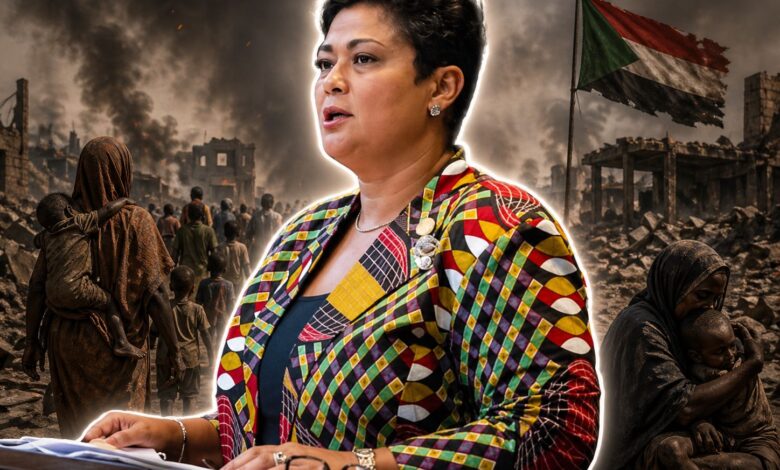
Ambassador Dr. Namira Najm, an expert in international law and migration, said that the crisis in Sudan She revealed what she described as a ”clear selectivity” in the application of international law standards, criticizing the international community’s disregard for the humanitarian aspect of the crisis, which is one of the worst crises humanity has faced in modern times.
10 million displaced Sudanese face an identity and property crisis after the war
She added, during her participation in an episode of EJIL: The Podcast of the European Journal of International Law, entitled “Is there anything international law can say about Sudan?” that what is happening in Sudan “is not just a humanitarian tragedy, but serious and systematic violations of international humanitarian law,” which requires reaching a peace agreement, and then holding those involved in the crimes committed against the Sudanese people accountable.
Najm believes that the conflict in Sudan is legally classified as a “non-international armed conflict,” despite the involvement of external parties who contribute weapons and mercenaries to fueling the conflict and deepening the humanitarian catastrophe that has befallen civilians.
Serious review
She explained that international law does not deal directly and effectively with proxy wars to punish states that intervene in internal conflicts in a way that leads to serious violations of international humanitarian law, while stressing that the rules of international law obligate all states not to supply any warring party with weapons that could potentially be used to commit crimes against humanity.
She added that this problem now requires serious review after what happened in Sudan and what happened in Gaza, explaining that the international community often focuses on holding the direct parties to the conflict accountable, while ignoring the parties that supported and helped them to achieve their interests, despite knowing that civilians were being targeted and the rules of law were being violated.
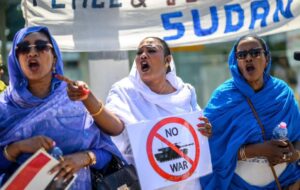
Regarding the delivery of humanitarian aid, the ambassador stressed that no warring party has the right to prevent food and medicine from reaching millions of civilians under any pretext, because international law criminalizes the use of starvation as a tool of war.
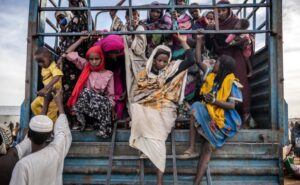
She added that the war in Sudan has caused an unprecedented internal displacement crisis, with the number of displaced persons and refugees ranging between 10 and 12 million people, including more than 9 million internally displaced persons, noting that a large number of them will face a crisis in proving identity and ownership, especially those whose homes were burned or destroyed, and who left without official documents proving their identity or ownership of their lands and homes.
Priority is achieving peace
She stressed that these problems must be addressed now, so that conflicts do not escalate again when the population returns to their villages and original areas.
Najm stressed that the priority should be to achieve peace and stability, and then move to the path of criminal justice without granting any party immunity from accountability.
She noted that, according to the rules of international law, the jurisdiction of the International Court of Justice in the Darfur case cannot be extended to include current crimes throughout Sudan.
She added that, realistically, the true will of the Sudanese people regarding the form of justice they want—whether through mixed or hybrid courts or customary mechanisms—cannot be verified until peace and stability are achieved, elections are held, and then a popular referendum is conducted on this path. Otherwise, a limited minority will decide on behalf of an entire people, which is difficult to accept if the goal is to achieve real stability in Sudan.
Participating in the discussion alongside her were Khulood Khair, director of Confluence Advisory, who addressed the repercussions of the conflict on the structure of the Sudanese state, and Muhannad Al-Nour, a prominent Sudanese human rights lawyer and member of the Darfur Bar Association, specializing in international criminal law and human rights, who has worked for years documenting violations and defending political detainees and activists in Sudan.
The discussion was moderated by Professor Sarah Nouwen, Professor of International Law at the European University Institute (EUI) in Florence, a Fellow of the University of Cambridge, and author of the seminal work "Complementarity in the Line of Fire: The International Criminal Court in Sudan and Uganda." She is a Sudan expert who has spent years studying how international law interacts with the political realities on the ground in Sudan.
EJIL: The Podcast, a platform of the European Journal of International Law, is one of the leading forums specializing in international law. It offers discussions that combine theoretical analysis and practical application, and sheds light on international issues from an in-depth legal perspective, making this episode an important reference for understanding the dimensions of the Sudanese crisis in the international context.