Nigeria opens gas gateway to Europe: Atlantic corridor linking 13 countries by 2031
A strategic project that is redrawing the energy map
Written by Omnia Hassan
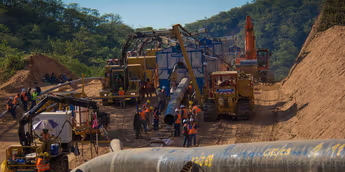
Exports are becoming increasingly important mystification Nigeria to Europe: Steps are accelerating to revive the Nigeria-Morocco gas pipeline project, which is expected to become a new energy corridor linking West Africa to the European continent by 2031. The ambitious project stretches along the Atlantic coast, passing through 13 countries, forming one of the longest offshore and overland gas pipelines in the world.
Europe is looking for safe alternatives
The recent unrest in the Strait of Hormuz and the accompanying sharp price increases Energy It brought back to the forefront Europe's need for stable and diversified energy sources, away from the volatility of the Middle East and its historical dependence on Russia.
In this context, the Nigerian-Moroccan project has emerged as a strategic option capable of enhancing European energy security via an Atlantic route less exposed to geopolitical risks.
Massive funding and rapid Moroccan moves
The National Office of Hydrocarbons and Mines (ONHYM) has begun an intensive campaign to secure the necessary funding for the project, which is estimated to cost around $25 billion.
This move is based on rising political and economic momentum, and a clear European desire to support projects that reduce the fragility of energy supply chains.
A supportive role for Senegal and Mauritania
The project is not limited to Nigerian gas only, as emerging producing countries such as Senegal and Mauritania are expected to contribute supporting supplies, which enhances the economic viability of the pipeline and consolidates regional energy integration along the Atlantic coast.
Roots of the idea and founding agreements
The project was officially launched in 2016 during the Moroccan monarch’s visit to Abuja, before the parties involved, with the support of the Economic Community of West African States (ECOWAS), signed agreements to move forward and feasibility studies.
In 2018, the initial engineering design phase was approved, which laid the technical foundation for the start of implementation.
The challenges of distance and the opportunity of time
The pipeline extends for about 7,000 kilometers to connect to the infrastructure in Spain, which has raised widespread doubts about its feasibility. However, the design capacity of 30 billion cubic meters per year, and the timeframe until 2031, give Nigeria an opportunity to expand its production and export capacities to keep pace with the expected demand.
A potential lifeline for European energy security
If the project is completed on schedule, it will give Europe a stable Atlantic outlet for gas and transform West Africa into a pivotal player in the global energy equation, at a time when there is a growing need to diversify sources and reduce risks.