Sudan's Foreign Ministry Undersecretary from Brazil: Our country's stability is key to the security of the Horn of Africa and the Red Sea
The involvement of mercenaries could have serious repercussions for the region.
Written by Ziad Abdel Fattah:
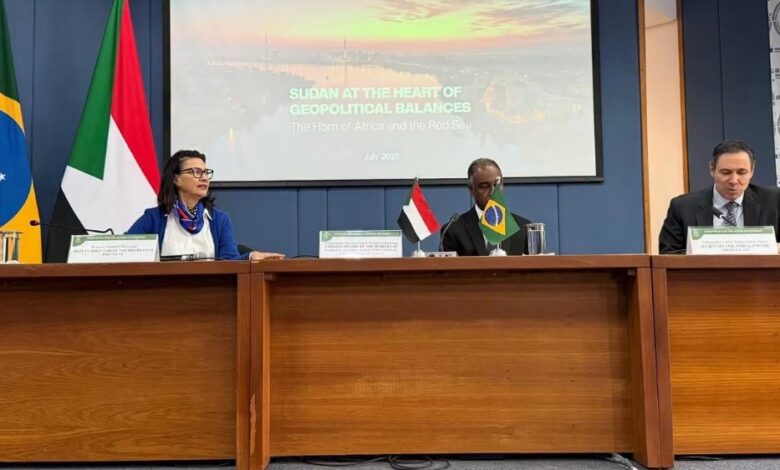
The Undersecretary of the Ministry of Foreign Affairs confirmed thatInternational Cooperation Sudan’s Ambassador, Muawiya Othman Khalid, said that the stability of Sudan is a fundamental pillar for the security of the Horn of Africa and the Red Sea region, warning that the continuation of the war will have security and regional repercussions that extend beyond the country’s borders.
This came during a lecture he delivered at the Rio Branco Institute of the Brazilian Ministry of Foreign Affairs, on the sidelines of his official visit to Brazil, where he is heading the Sudanese delegation participating in the meetings of the Political Consultative Committee held in the capital, Brasilia, in the presence of diplomats, academics and a number of Arab ambassadors.
Sudan's war is linked to its regional environment
During his speech, the Sudanese Foreign Ministry Undersecretary reviewed the geopolitical dimensions of the crisis, explaining that the war in Sudan cannot be separated from its regional and international context, given the strategic location the country occupies in the Horn of Africa, the Nile Basin, and the Red Sea.
He said that the stability of Sudan directly impacts the security and stability of the countries in the region, considering that the continuation of the conflict and what he described as the involvement of mercenaries in it could lead to serious repercussions for the entire region.
He pointed out that the Sudanese government believes the war is witnessing external support and a proxy war, stressing that it had warned since the outbreak of the conflict about the repercussions of this on regional security.
Ambassador Muawiya Othman Khalid addressed what he described as violations committed by the Rapid Support Forces, pointing to the targeting of civilians and infrastructure using drones and other combat methods, according to the official narrative of the Sudanese government.
He also reviewed Khartoum’s position on regional and international initiatives aimed at ending the conflict, and provided an explanation of the peace initiative that the Sudanese government had presented to the UN Security Council last December, as a proposed framework for advancing political settlement efforts.
At the end of the lecture, the Sudanese Foreign Ministry Undersecretary called on regional and international parties to adopt an approach based on a realistic understanding of the nature of the crisis in Sudan, warning that the continuation of the conflict could create a favorable environment for the activity of terrorist groups and threaten the security of international navigation and trade in the Red Sea.