The Five Giants: How will Africa's major powers redraw the continent's economic map in 2026?
Unprecedented concentration of economic power
Written by Omnia Hassan
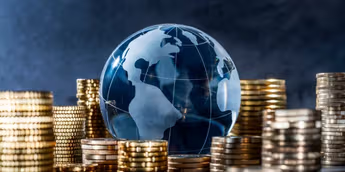
The latest IMF forecasts point to a significant shift in the economic landscape. AfricanIt is expected that just five countries will dominate about 50% of the continent’s total GDP by 2026, which is estimated at about $3.6 trillion. This concentration reflects a profound change in the balance of growth and investment within the continent.
The five most influential countries
South leads Africa The list has a GDP of nearly $480 billion, benefiting from an advanced industrial base and a strong financial sector. Egypt comes in second with about $430 billion, driven by infrastructure projects, tourism and the Suez Canal.
Nigeria ranks third with $377 billion despite inflationary pressures and currency devaluation, while Algeria comes in fourth with $317 billion thanks to energy revenues. Morocco completes the list with $194 billion, bolstered by the rise of industry and exports.
Drivers of growth and economic transformation
These economies rely on different pillars; South Africa benefits from mining and financial services, while Egypt is expanding its industrial and service base. In Nigeria, oil and technology remain key drivers despite the challenges. Algeria is based on natural gas, while Morocco is consolidating its position as a rising industrial and logistics hub.
Risks of economic concentration
Although this concentration may boost investment and drive regional growth, it presents a real challenge in the widening gap between major economies and smaller countries that suffer from weak manufacturing and dependence on primary commodities.
A more diverse future?
Economists predict that the coming years will see the emergence of new powers such as Kenya, Ethiopia and Tanzania, with a shift in focus towards manufacturing, technology and vital minerals, which could radically redraw the map of the African economy over the next decade.
Despite the current dominance of the five major economies, rapid demographic and economic shifts within the continent suggest that the landscape will not remain static.
With increasing investments in digital infrastructure, expanding industrial value chains, and rising global demand for vital minerals, emerging African countries have begun to redefine their economic roles.
This transformation not only reflects a race for growth, but also a gradual shift from a raw resource-based economy to a more diversified model based on innovation, manufacturing and services, which may open the door to a more balanced African economic map in the coming years.