A Libyan researcher told Zoom Africa: What Mali is witnessing reflects a complex interplay between international competition and state weakness.
The Sahel region suffers from security fragility.
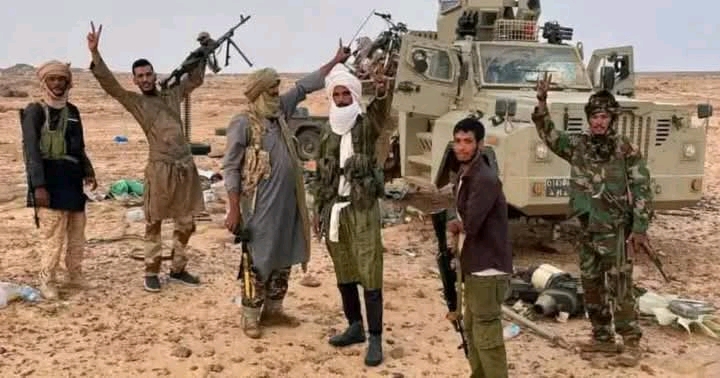
Idris Ahmed, a Libyan researcher in international political affairs, said that Mali has recently witnessed remarkable field developments, represented by the Azawad forces’ control over major cities such as Kidal and Gao, in addition to the extension of clashes towards the capital, Bamako. He explained that these transformations reflect a qualitative change in the nature of the conflict, as it is no longer limited to a traditional rebellion in the north, but has become closer to an attempt to reshape the balance of power within the state.
A pivotal development in the course of the conflict
In an exclusive statement to Zoom Africa, he added: “What happened in Kidal represents a pivotal development in the course of the conflict, as its capture not only has a military dimension but also profound political and symbolic significance, given its historical importance as the Tuareg center of gravity. This reignites separatist sentiment in the north and simultaneously reveals the decline of state influence and the imbalance of power in that region.”.
He continued: “The ability of these groups to carry out coordinated and simultaneous operations on more than one front reflects a level of organization and planning, which is countered by a decline in the state’s ability to impose its full control. In contrast, the extension of the clashes to Bamako reflects the transfer of the conflict to the heart of the state, which puts the concept of internal security in direct challenge.”.
The Libyan researcher added: This scene brings to mind the experience of Operation Barkhane, which ended with withdrawal without achieving lasting stability, which reflects that changing the external actor did not translate into a radical solution, but rather into reproducing the crisis in different forms.
He stressed: In the context of international competition, talk of the existence of parties that do not want stability in the region remains within the framework of analysis, without relying on conclusive evidence. However, some of these behaviors can be understood within the framework of countries seeking to protect their interests and enhance their influence in the Sahel region. In general assessment, what Mali is witnessing reflects a complex overlap between international competition, weak state institutions, and the multiplicity of armed actors, which makes the crisis likely to continue and reproduce itself instead of reaching a quick solution.
The Sahel region suffers from security fragility.
Ahmeid concluded: In a broader context, what is happening in Mali cannot be separated from its regional environment, as the Sahel region suffers from chronic security fragility, which makes the possibility of the conflict spreading to neighboring countries possible, and increases the risk of it turning into a state of prolonged regional instability.