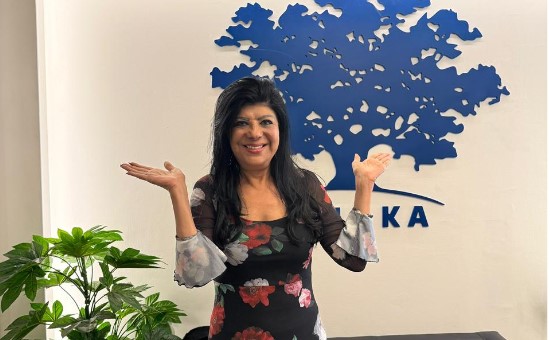
Dr. Iman Bibars in an interview with Zoom Africa News: Africa is not a continent of crises... and we will remain in Egypt in the future through the One Africa Summit
The Women Social Entrepreneurs Initiative Foundation: African youth must transform from opportunity seekers to opportunity creators
Interview conducted by: Bader Ahmed
At a time when economic, social, and environmental challenges are mounting across the African continent, the role of social change leaders is emerging as a key driver of sustainable development and community-based solutions. While the stereotypical image of Africa remains associated with crises and conflicts, inspiring examples of innovation and community leadership are being spearheaded by young people, women, and social entrepreneurs striving to create real and lasting change.
In this context, Zoom Africa News conducted a special interview with Dr. Iman Bibars, founder and director of Ashoka Arab World, global vice president of Ashoka Global, and founder and global director of the Women Social Entrepreneurs Initiative, to talk about Ashoka’s vision in Africa, the future of social entrepreneurship on the continent, the most prominent challenges facing change leaders, in addition to efforts to empower youth and women, and behind the scenes of preparations for the upcoming One Africa Summit in Egypt, which aims to enhance cooperation between change leaders and impact makers from across the African continent. And to The text of the dialogue...
How do you see Ashoka's vision in Africa? And what distinguishes it from other regions of the world?
Ashoka is the world’s largest network of social change leaders, operating in more than 95 countries around the world, and believes in the fundamental principle that every human being is capable of creating change.
In Africa, this vision has a special significance, as the continent possesses enormous youthful energy, but at the same time it faces complex challenges including poverty, unemployment, poor services, climate change, conflicts and gender inequality.
We don't focus on providing temporary solutions to problems; we seek out individuals capable of transforming systems themselves. Instead of simply providing aid for education, we support those who develop new educational models, and instead of offering traditional healthcare services, we look for those who redesign how marginalized groups access healthcare.
Africa is characterized by the fact that much of its innovation stems from local communities, villages, and marginalized areas, which makes the solutions more realistic and flexible.
Ashoka also has five regional offices covering North, East, West and Southern Africa, all of which collaborate to implement a common strategy based on empowering individuals to create change, by working with social entrepreneurs, youth, schools, universities and governments.
What attracted you to working in the field of social change leadership in Africa?
I believe that Africa is not a poor continent, but a continent whose potential has been weakened by decades of colonialism, economic injustice, and poor distribution of resources.
What attracted me to this field was seeing the real impact of a single idea led by someone who believes in their cause, and how it can change the lives of thousands or millions of people.
I have worked for years with women, youth and marginalized groups, and I have seen that people need not only assistance, but also opportunity, trust and a system that supports the unleashing of their latent potential.
Despite the economic and political challenges, we find young people innovating solutions in agriculture, energy, education, technology and health with very limited resources, which is extremely inspiring.
I also believe in the importance of cooperation between countries of the South and the exchange of experiences between African countries, as it is one of the keys to achieving independent development for the continent.
What are the main areas that Ashoka is currently focusing on in Africa?
Ashoka operates in several areas, but key priorities include:
Empowering youth and creating a generation of leaders and opportunity creators.
Redefining education to focus on skills such as empathy, leadership, teamwork, and problem-solving.
Empowering women economically, socially, and politically.
Supporting innovation in the areas of health, climate, and sustainable agriculture.
Building a more inclusive economy that balances economic growth and social justice.
One of the most prominent initiatives we are working on is the WISE initiative to support socially leading women in Africa and the Arab world.
What are the main challenges facing social entrepreneurship in the continent?
There are several key challenges, the most prominent of which are:
First: Limited funding, as some investment entities still view Africa as a high-risk region.
Second: The weakness of the legislative environment in some countries, and the lack of clear legal frameworks for social institutions.
Third: The traditional view that limits change to governments only, while civil society and change leaders have a pivotal role.
Fourth: The migration of skilled and young minds in search of better opportunities.
Despite these challenges, I am very optimistic about the capabilities of the new African generation.
How do you deal with cultural and economic diversity among the countries of the continent?
Africa is not a single entity, but a continent that is extremely diverse culturally, linguistically, and economically.
At Ashoka, we do not believe in transferring a ready-made model from one country to another, but rather we always begin by understanding the local context, listening to communities and working with them.
What works in Kenya may not work in the same way in Egypt, Morocco, or Nigeria, so we rely on local leaders who understand the needs of their communities.
We also encourage the exchange of experiences between African countries, and we view diversity as an opportunity for learning, not an obstacle to cooperation.
What is Ashoka's role in empowering women and youth as leaders of change?
Empowering women and youth is a key part of our work.
With regard to women, it is not just about economic empowerment, but also about changing the mindset and enhancing the role of women in decision-making.
As for young people, we believe that they are not only the leaders of the future, but also the leaders of the present, so we work with schools, universities and various institutions to build their leadership, empathy and teamwork skills.
We also provide them with opportunities to join the Ashoka global network and connect with private sector partners and potential funders to support their ideas and projects.
How can individual initiatives be transformed into sustainable public policies?
This is one of the fundamental pillars of Ashoka's philosophy, which is based on the concept of changing systems.
Any successful initiative will not have a wide impact if it remains a limited-scale project.
Therefore, we are working to build partnerships with governments, the private sector, universities and the media, produce evidence and data that prove the success of innovative models, and form community alliances capable of expanding the scope of impact.
I believe that Africa has a historic opportunity today to develop more equitable and humane development models, if real investment is made in the African people and their capacity for innovation.
What about the One Africa initiative and the upcoming summit in Egypt? What is the idea? And how is it being worked on?
The One Africa idea stems from our belief that one of the biggest challenges facing the continent is the continued thinking and working in separate regions, even though the world views Africa as a single entity.
Despite the similarity of the challenges and opportunities, there are still psychological, cultural, linguistic and economic barriers between parts of the continent.
Hence came the idea of One Africa, as a vision to build a shared African space led by social change leaders, youth, and impact makers.
We are currently working on organizing the One Africa Summit, in Egypt next October, to bring together change leaders, institutions and youth from across the continent.
The summit’s main objective will be to build genuine partnerships and share successful African experiences and solutions, with a focus on issues of youth and women’s empowerment, social innovation, education, climate, migration, and building a more equitable economy.
Bebars concluded by saying: “Africa is not just a continent of crises, but a continent of solutions, innovation, and immense human potential. The One Africa initiative is a call to build a more cooperative and confident African identity, one more capable of shaping its own future.”.