Map of African exports: What does each country export?
From oil to cars: How are African countries' exports distributed?
Written by: Badr Ahmed
The African continent possesses one of the richest natural resource bases in the world, but the structure of its exports reveals that most of its economies continue to depend on exporting raw materials, whether oil, gas, minerals or agricultural products, while the contribution of manufacturing industries remains limited in most countries.
Data from Afreximbank and the OEC Observatory of Economic Complexity show that oil, minerals and agricultural crops form the backbone of African exports, with notable exceptions of countries that have succeeded in developing value-added export industries.
An analysis of the continent's wealth and economic opportunities
In North Africa, Algeria, Libya and Egypt continue to rely mainly on oil and natural gas exports, which constitute the largest source of foreign revenue.
In contrast, Morocco has succeeded in building a sophisticated industrial base that has made cars its largest export, making it one of the most important automotive manufacturing centers on the continent, while Tunisia relies on exporting electrical wires and car components to European markets, in a model that reflects its success in integrating local industries into global production chains.
In West Africa, the region stands out as a global hub for the production of gold, cocoa, iron, and bauxite. Ghana, Mali, Burkina Faso, and Sudan are among the largest gold exporters, while Guinea leads in bauxite exports, the primary raw material for aluminum production.
African trade: between abundant resources and weak manufacturing
Ivory Coast and Cameroon also maintain their positions among the world's top cocoa producers, while Nigeria relies on oil and gas as its main source of export revenues, despite efforts to diversify the economy.
In Central Africa, economies are heavily reliant on natural resources. Chad, Gabon, the Republic of Congo, Equatorial Guinea, and South Sudan depend on oil exports.

While the Democratic Republic of Congo possesses one of the world's largest reserves of copper and cobalt, two essential minerals in the manufacture of batteries and electric vehicles, Cameroon exports cocoa, and the Central African Republic relies on timber.
In East Africa, exports are more diversified, with Ethiopia and Uganda being famous for coffee, Kenya being a major exporter of tea and flowers, while Tanzania, Rwanda and Burundi rely on gold.
Somalia also relies on livestock exports, while Djibouti acts as a re-export and logistics hub, benefiting from its strategic location on the Red Sea.
South African exports to the world
In southern Africa, mineral wealth dominates foreign trade. South Africa leads in platinum exports, while Botswana is one of the world's largest diamond exporters, Zambia relies on copper, Namibia on uranium, and Zimbabwe on gold. Angola exports oil and diamonds, Madagascar relies on nickel, Mauritius is famous for textile exports, and Eswatini for essential oils.
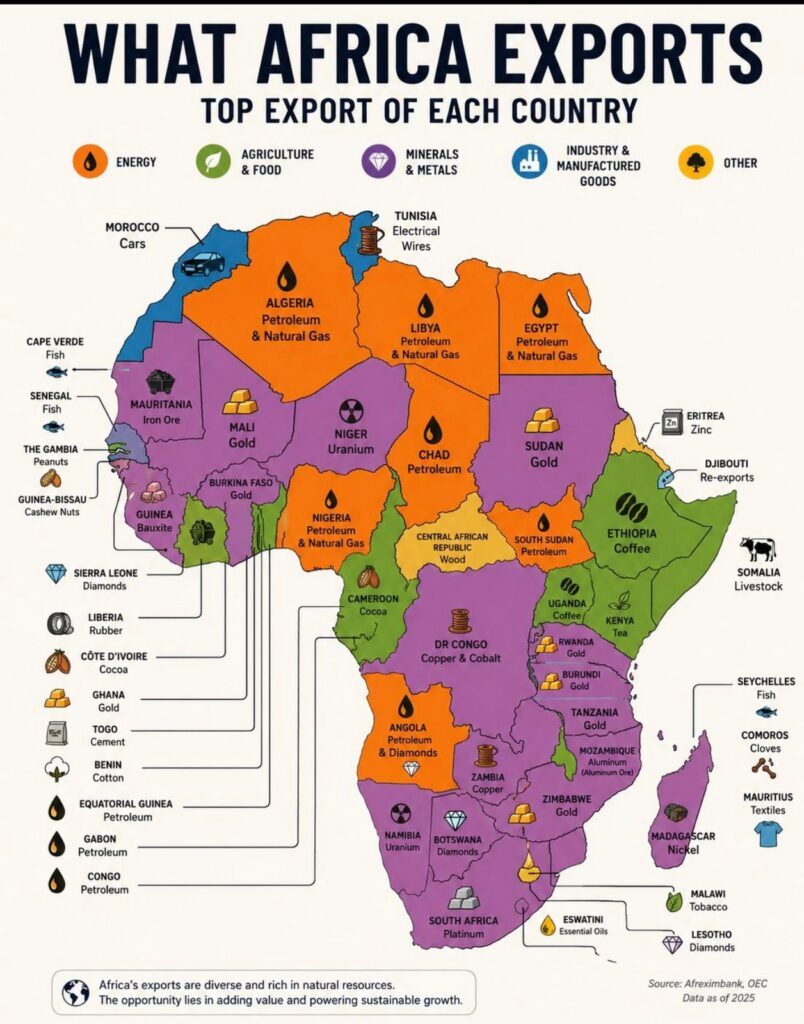
The continent's trade map reveals that most African countries still export raw materials without processing, depriving them of greater added value. For example, cocoa-exporting countries still earn significantly less than chocolate-producing countries, and the same applies to oil and minerals, which are exported in their raw form before being processed abroad.
Nevertheless, some successful experiences are emerging within the continent, most notably Morocco in the automotive industry, Tunisia in the electrical industries, and Mauritius in the textile industries. These are models that confirm that investment in manufacturing can raise the value of exports, create jobs, and increase the competitiveness of African economies.
Afreximbank believes that the African Continental Free Trade Agreement represents a historic opportunity to reshape the structure of trade within the continent, by encouraging local manufacturing, increasing intra-regional trade, and developing regional value chains in the mining, agriculture, food and pharmaceutical industries.
Secrets of Africa's export map
The bank also calls for investment in infrastructure, energy and logistics, as key factors for increasing exports and attracting investment.
With the global shift towards clean energy, Africa has an exceptional opportunity to benefit from its huge reserves of copper, cobalt, lithium, manganese and uranium, minerals used in the manufacture of batteries, electric cars and renewable energy technologies, giving the continent a strategic position in the global economy in the coming decades.
The African export map confirms that the continent possesses enormous wealth, but the real challenge lies in transitioning from exporting raw materials to manufacturing them locally. Strengthening manufacturing, developing value chains, improving infrastructure, and increasing intra-African trade remain the fastest paths to transforming natural resources into sustainable economic development, thus solidifying Africa's position as one of the world's leading economic powers in the future.