Ahmed Salem
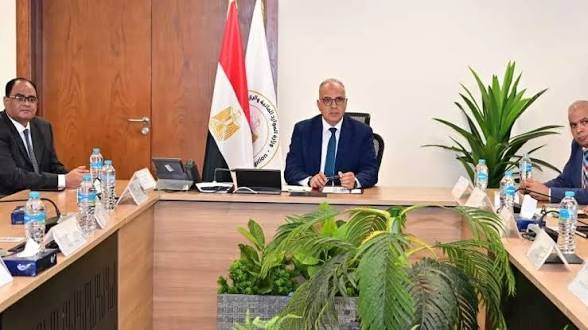
The Permanent Committee for Regulating the Nile River Inflow held its periodic meeting, chaired by Professor Dr. Hani Sweilem, Minister of Water Resources and Irrigation, to follow up on the Nile River Inflow and the water situation, within the framework of continuous monitoring during the period of peak water needs.
The committee reviewed the developments in the operation of the illegal Ethiopian dam, which violates international law, and the disturbances and changes in discharge rates that have occurred in the past period as a result of the continued unilateral management of the dam, in the absence of clear operating rules and a regular mechanism for exchanging data through a legally binding agreement between Ethiopia and the downstream countries.
Review of operating scenarios
The committee explained that this situation requires the operators of dams and water facilities located behind the dam to continuously review and update their operating scenarios, in order to ensure the maintenance of efficient water resource management and to deal with various hydrological variables.
The committee also reviewed the rainfall situation on the sources of the Nile and the quantities of water coming from the Blue Nile, the White Nile and the Atbara River, where indicators showed that the water inflow during the month of June was higher than its average.
While revenues for July to date have been below average, the committee confirmed that these indicators do not currently allow for an accurate assessment of the year's flood situation.
Its indicators will become clearer after the first ten days of August, with a large portion of the Blue Nile revenue coming in during the second half of July and the beginning of August, especially since the Blue Nile revenue during the last ten days of July represents about 50% of the total revenue for the month.
The committee also explained that the accuracy of flood forecasting gradually increases as the rainy season progresses and more hydrological and climatic data become available.
Latest indicators issued by regional centers
The committee also followed up on the latest indicators issued by regional and international climate centers regarding the development of the “El Niño” and ”La Niña” phenomena and their potential impacts on rainfall patterns in a number of regions of the world, including East Africa.
The committee stressed that these indicators represent one of the important elements taken into account when preparing seasonal forecasts, but their impact on the rainfall of the Nile Basin remains linked to a range of climatic and regional factors, which necessitates continued monitoring and periodic updating of forecasts as the rainy season progresses, and linking them to actual monitoring data received from various areas of the basin.
The Nile: A changing hydrological nature
The committee stressed that the Nile River has a changing hydrological nature, as its behavior experiences natural fluctuations at the daily and seasonal levels. Therefore, assessing the water situation depends on the integrated analysis of various hydrological and climatic indicators, and not on short-term changes alone, in order to ensure that operational decisions are made on accurate scientific grounds.
Dr. Sweilem directed the continuation of daily monitoring of rainfall and water inflow indicators, and the continuous updating of hydrological and climatic forecasts, in order to enable the ministry’s agencies to update operational scenarios and take the necessary measures in a timely manner, in order to achieve optimal management of water resources.
Monitoring hydrological indicators
Dr. Sweilem emphasized that the water resources management system in Egypt relies on real-time monitoring of all hydrological and climatic indicators, and the dynamic operation of water facilities, which allows for efficient handling of various hydrological scenarios.
He also stressed that the High Dam will remain a fortress of safety for Egyptians and the cornerstone of Egyptian water security, with its storage and operational capabilities that enable it to deal with various hydrological conditions, while ensuring that water needs for all uses are met.
Dr. Sweilem stressed the importance of continuing work and ongoing monitoring in all departments of the Ministry at the national level, and coordination between the various concerned parties, to ensure that water needs are met, and to deal immediately and effectively with any new developments, in order to ensure the stability and efficiency of the water resources management system.