Sudan rejects US sanctions and demands Washington provide evidence of alleged chemical weapons use.
Written by: Ayman Ragab
The Sudanese government rejected the new US sanctions imposed on it over accusations of using chemical weapons, describing them as based on “false claims” and driven by “purely political motives,” and demanding that the United States provide the evidence it claims to possess.
The United States had announced that additional sanctions imposed on Sudan would take effect from July 20, 2026, after it determined that the Sudanese government had not met the requirements stipulated in the Chemical and Biological Weapons Control Act within a three-month deadline.
The sanctions include a ban on the provision of loans or financial and technical assistance to Sudan by international financial institutions, with the exception of humanitarian and food aid, along with imposing broad restrictions on the export of most American goods and technologies to Sudan, with products with security or military uses subject to strict review under the “presumption of rejection” policy.
These measures are scheduled to remain in place for at least one year, unless the US administration decides that Sudan has met the legal requirements for lifting them.
Unilateral and illegal sanctions
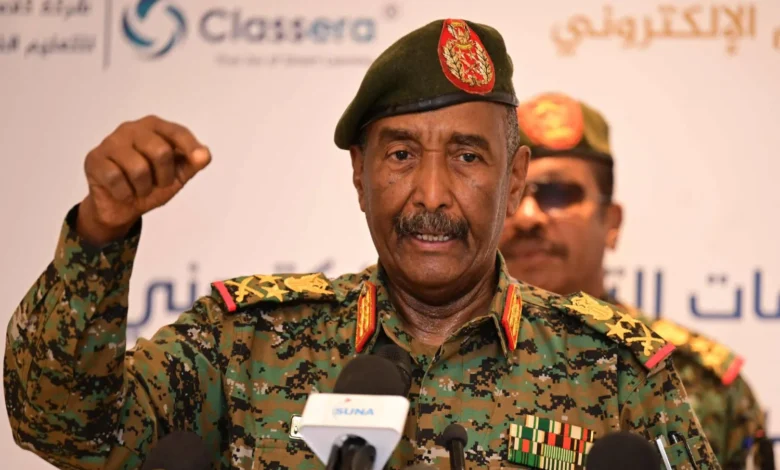
In a statement issued Sunday evening, the Sudanese Foreign Ministry confirmed its categorical rejection of what it described as ”unilateral and illegal sanctions” announced by the United States, considering them to be based on baseless accusations regarding the use of chemical weapons by the Sudanese Armed Forces.
The ministry stressed Sudan’s full commitment to relevant international agreements and its continued cooperation with relevant organizations, foremost among them the Organization for the Prohibition of Chemical Weapons.
She added that Khartoum had already refuted these accusations since they were circulated in the media, stressing that they are based on unknown sources and lack any reliable evidence.
The government also reaffirmed its commitment to the Convention on the Prohibition of the Development, Production, Stockpiling and Use of Chemical Weapons and on their Destruction, noting that it has fulfilled all the obligations stipulated in the Convention, including submitting periodic notifications and not producing, possessing or using this type of weapon, pointing out that Sudan is a member of the Executive Council of the Organisation for the Prohibition of Chemical Weapons.
Washington ignored the technical and legal mechanisms stipulated in the Chemical Weapons Convention.
The Foreign Ministry explained that Khartoum cooperated with the United States and expressed its readiness to take all the necessary technical and procedural steps to verify any allegations, but it said that Washington did not provide any evidence that could be relied upon, and ignored the technical and legal mechanisms stipulated in the Chemical Weapons Convention before making the decision to impose sanctions.
The ministry considered this step to confirm that the motives for the sanctions are “purely political” and do not reflect a genuine concern to prevent the use of chemical weapons, adding that this brings to mind previous instances in which the United States used similar accusations to achieve political goals.
Khartoum called on Washington to abide by the established legal mechanisms and to fulfill its bilateral commitment to provide the evidence it claims to possess.
In May 2025, the United States imposed initial sanctions on Sudan over allegations of the use of chemical weapons during the conflict with the Rapid Support Forces in 2024. These measures included restrictions on US exports to Sudan, as well as restrictions on access to US government credit lines.
The Sudanese government rejected those accusations, while the head of the Transitional Sovereignty Council, Abdel Fattah al-Burhan, issued a decision on May 29, 2025, to form a national committee to investigate the American allegations regarding the Sudanese army’s use of chemical weapons during the war with the Rapid Support Forces.
Since mid-April 2023, the Sudanese army and the Rapid Support Forces have been waging a war that has killed more than 20,000 people and caused the displacement and refuge of about 15 million, according to data from the United Nations and local authorities, while a study prepared by American universities estimated the number of deaths at about 130,000.